Former CIA agent Bob Baer says
On February 17, 2003 as more than 3 million protesters gathered in Rome against the imminent war in Iraq, with millions more protesting in cities around the world, Sabrina de Sousa was
She was one of more than 20 convicted in 2009 in absentia of orchestrating the rendition of Abu Omar from Italy to Egypt.
She was denied immunity from the State Department and has been fighting ever since to clear her name and hold those who are responsible accountable for the kidnapping and torture of an innocent man. The CIA has denied the existence of records
Hassan Mustafa Osama Nasr, known as Abu Omar, a radical Egyptian cleric, had lived in Italy since 2001 (according to the Italian arrest warrant for Betnie Medero, Vincent Faldo and James Thomas Harbison) after receiving political asylum after the Egyptian government alleged that he was part of a terrorist group.
In 2002 Egypt issued an arrest warrant for him after it was requested that they do so by Jeffrey Castelli.
While in Italy, Abu Omar spoke out publicly and vehemently against U.S. military action in Iraq prior to the March 2003 invasion. Italy responded by placing him under surveillance.
However at the time of his rendition Abu Omar was not under investigation.
The Kidnapping
The court referred to Omar as a “[m]ilitant in Egypt of the Egyptian extremist organization Gama’a al Islamiya.” (footnote 1 pg 172)
The Trial
The State Department only invoked diplomatic immunity for one person, Robert Seldon Lady, allegedly the CIA station chief in Milan.
"Lady received a sentence of eight years. The Italian judge found that a third alleged CIA operative, Jeffrey Castelli, the alleged CIA station chief in Rome, could not be convicted because he possessed diplomatic immunity."
In 2009 de Sousa sued the State Department for failing to invoke diplomatic immunity, and in November 2014

Abu Omar Rendition

In a 2007 Congressional hearing (video 2hrs 39) former CIA agent Michael Scheuer testified that
Page 6
What is Rendition and why was it used? Amnesty International said in a statement for the record that
Julianne Smith, director and senior fellow, Europe program at the Center for Strategic and International Studies (CSIS), told the hearing that (PDF pg 6)
How rendition hurts US intelligence relationships with other countries
pg 9
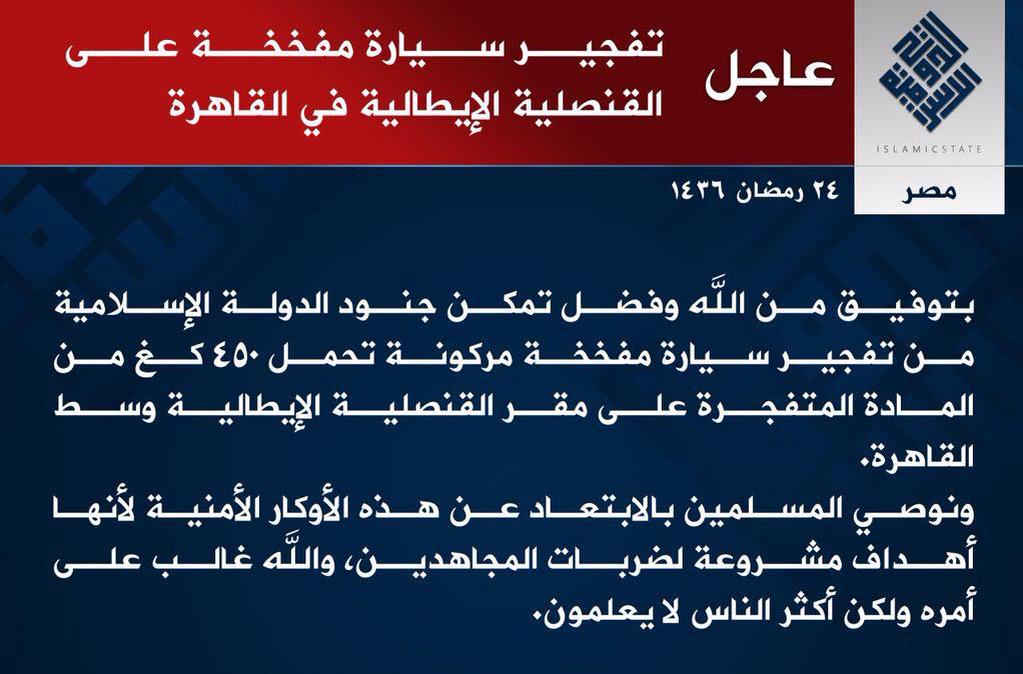
Recently the link between Egypt and Italy has been in the news again as ISIS claimed responsibility for bombing the Italian consulate in Cairo.
NYT
Carol Grayson says that the group is the former affiliate
If you want a serious interrogation, you send a prisoner to Jordan.
If you want them to be tortured, you send them to Syria.
If you want someone to disappear - never to see them again - you send them to Egypt.Mother Jones reported that
Then-CIA director George Tenet testified before the 9/11 Commission that there were more than 80 renditions before September 11, 2001. We found information on 29 cases of extraordinary and ordinary rendition prior to 9/11. Of the 14 that qualify as extraordinary renditions, 12 were to Egypt.This is the story of Abu Omar, a prisoner sent to Egypt that we heard from again, and Sabrina de Sousa, one of the CIA agents charged in his rendition case of kidnapping. Both continue to fight for justice more than 10 years later. Abu Omar's case was heard on June 23, 2015 at the European Court of Human Rights. Italy denied it's role in the rendition, claiming that Abu Omar
“was captured exclusively by CIA agents”, Paolo Accardo, lawyer for the Italian government, told the European Court of Human Rights in Strasbourg.
“The applicant was never – not even for one moment – in the hands of Italian authorities, nor has he been lawfully detained for some time by Italian authorities,” said Accardo.The Rendition
On February 17, 2003 as more than 3 million protesters gathered in Rome against the imminent war in Iraq, with millions more protesting in cities around the world, Sabrina de Sousa was
chaperoning her son’s high school trip at Madonna Di Campiglio, a popular ski area in northern Italy.Working for the CIA since the mid-1990's, she was transferred to the US Consulate in Milan in the spring of 2001.
She was one of more than 20 convicted in 2009 in absentia of orchestrating the rendition of Abu Omar from Italy to Egypt.
She was denied immunity from the State Department and has been fighting ever since to clear her name and hold those who are responsible accountable for the kidnapping and torture of an innocent man. The CIA has denied the existence of records
pertaining to the U.S. government's investigation of Abu Omar's rendition as well as determinations concerning the government's obligation to defend her.
Hassan Mustafa Osama Nasr, known as Abu Omar, a radical Egyptian cleric, had lived in Italy since 2001 (according to the Italian arrest warrant for Betnie Medero, Vincent Faldo and James Thomas Harbison) after receiving political asylum after the Egyptian government alleged that he was part of a terrorist group.
In 2002 Egypt issued an arrest warrant for him after it was requested that they do so by Jeffrey Castelli.
While in Italy, Abu Omar spoke out publicly and vehemently against U.S. military action in Iraq prior to the March 2003 invasion. Italy responded by placing him under surveillance.
However at the time of his rendition Abu Omar was not under investigation.
The Kidnapping
Around noon on Monday, Feb. 17, 2003, Abu Omar left his apartment on Via Guerzoni in Milan for his daily walk to his mosque. Some at the CIA believed he had been plotting a 2002 attack against a bus full of students headed to an American school in Milan, Italian court records say.
A small car purred alongside him. Then a big white van. An Italian law enforcement official, who was collaborating with the CIA team, stepped out of the car and asked to see Omar’s identification. Moments later, two men burst out of the van. Omar, a hefty man, then about 40, was forced into the back. His mouth was taped shut. His feet and hands were bound. He was blindfolded, according to Italian court documents.
Hours later, the van sped onto Aviano Air Base in northeast Italy. From there, Omar was flown to a U.S. air base in Germany, then on to Egypt, where he was thrown into a Cairo prison. He was beaten, his wife told Italian investigators, according to the court documents. His genitals, she said, were subjected to electric shocks.(Harvard National Security Journal footnote 2 page 2)
The abduction purportedly derailed Italy’s investigation of Omar. An Italian counterterrorism prosecutor claimed that “if Abu Omar had not been kidnapped, he would now be in [an Italian] prison, subject to a regular trial, and we would have probably identified his other accomplices.”Italian counter-terrorism officials claimed that Omar fought in Bosnia and Afghanistan and recruited fighters for extremist Islamic causes. Omar’s attorney acknowledged that Omar illegally entered Italy in 1997 but that prior to that he had merely been traveling in Jordan, Yemen, Albania, and Germany. (MSNBC)
The court referred to Omar as a “[m]ilitant in Egypt of the Egyptian extremist organization Gama’a al Islamiya.” (footnote 1 pg 172)
The Trial
By analyzing cell phone records Italian prosecutors were able to "In July 2006, the prosecutor issued an arrest warrant for De Sousa, whom he identified as one of the four U.S. officials mainly responsible for the alleged kidnapping."
Abu Omar ultimately was not charged with a crime and was released in February 2007.
That same month, an Italian judge indicted 26 U.S. government officials, including the plaintiff, for their alleged roles in the kidnapping. Six Italian officials were also charged. Abu Omar, for his part, filed a separate civil suit in Italy.
Sabrina de Sousa returned to the United States in early 2004 after finishing her tour of duty in Italy. (Pg 3, Opinion, Sabrina de Sousa vs State Dept)
The State Department only invoked diplomatic immunity for one person, Robert Seldon Lady, allegedly the CIA station chief in Milan.
"Lady received a sentence of eight years. The Italian judge found that a third alleged CIA operative, Jeffrey Castelli, the alleged CIA station chief in Rome, could not be convicted because he possessed diplomatic immunity."
In 2009 de Sousa sued the State Department for failing to invoke diplomatic immunity, and in November 2014
She submitted FOIA requests to State, the CIA, and the Department of Defense for records pertaining to the U.S. government's investigation of Abu Omar's rendition as well as determinations concerning the government's obligation to defend her. The CIA issued a Glomar response neither confirming nor denying the existence of records. The other agencies did not substantively respond to her requests and De Sousa finally filed suit.According to an exchange with a prosecutor, Mr Spataro, Abu Omar may have been kidnapped in order to recruit him as an agent.
"With regard to the question of whether Abu Omar had been kidnapped with the objective of recruiting him, Mr Spataro said that it was possible that there had been attempts to recruit him after the kidnapping, but he did not consider that Abu Omar’s possible recruitment was the aim of the kidnapping."Map of CIA Rendition Flights from Mother Jones
Abu Omar Rendition

In a 2007 Congressional hearing (video 2hrs 39) former CIA agent Michael Scheuer testified that
to the best of my knowledge, not a single target of rendition has ever been kidnapped by CIA officers. The claims to the contrary by the Swedish Government regarding Mr. Aghiza and his associate and those by the Italian Government regarding Abu Omar are either misstatements or lies by those governments.An Italian arrest warrant issued on September 27, 2005 goes into more details about the torture Abu Omar endured, including threats made against his family as well.
Page 6
he added that he was made to sign a statement after the torture where he declared he had turned himself in to the Egyptian authorities of his own free will…
According to my husband, at first the Egyptians were astounded at having him there with them; this fueled my husband’s belief that he had not been kidnapped by Egyptians.. once freed, the Egyptian authorities told him he could go back to his work in Egypt, open up a store or even take up studying again, but he had to stay away from spreading any kind of Islamic propaganda. Some of the details I am recounting have also been learnt by my sister-in-law… I cannot provide precise information as to the traumas he endured.. I heard about the torture from his kin... at any rate, he said he had lost about 20 kilos as a result of the detention.. I do not believe my husband was able to provide any of the information they were after.. they merely ordered him to quit his propaganda activities..Here from pages 7-8
"He had to meet an important personality.. the Egyptian Home Secretary HABIB AL ADLY…. In fact the minister… basically told him that if he agreed to work as an infiltrator for the Egyptian secret service, he would be home in 48 hours… otherwise he would have to bear full responsibility for his refusal.. Abu Omar refused.. he was forthwith taken to other Cairo premises, also managed by the secret service, where he stayed continually until his release on April 20th 2004.. He was subjected to serious torture.. the first measure was to leave him in a room where incredibly loud and unbearable noise was made.. he has experienced damage to his hearing.. The second kind of torture was to place him in a sauna at tremendous temperature and straight after to put him in a cold storeroom.. occasioning terrible pain to his bones.. as if they were cracking.. The third was to hang him upside down.. and apply live wires to the sensitive parts of the body including his genitals.. and producing electric shocks.. he has suffered damage to his motory and urinary systems.. he became incontinent.. They tortured him accusing him of being an Al Quaeda terrorist and a militant against the Egyptian regime.. they wanted to wrest information from him that he was unable to give.. they told him to consider himself, along with myself, Abu Imad (i.e. the imam of V.le Jenner) and Abu Saleh as terrorists … and that sooner or later the same fate would befall the three of us.. they would catch us as soon as possible.. they said they had agreements with the Italian authorities… that could easily ensure our capture.. If we didn’t turn ourselves in voluntarily.. they would kidnap us…
He told me the torture had been particularly ferocious for the first seven months in detention.. it had then diminished.. except whenever questions were asked about his role and his alleged involvement.. in the final stage of detention.. he underwent medical treatment.. also after his release.. He told me that he had been summoned one day by one of the superintendents of the secret service, who said that if he wanted to get out alive from that jail, he would have to declare he had left Italy for Egypt voluntarily, in order to clear his position.. he would have to keep quiet on everything else.. from the abduction to the torture.. they told him they would find out about any violation of the rules since everything was “under surveillance” also with the backing of the Egyptian judiciary.. if he rejected this proposal.. he would not leave the prison alive.. Before making a decision Abu Omar consulted other inmates.. who told him nobody gets out alive from that jail.. so they told him to accept.. So he did.. he was taken to an office in Alexandria.. he brother was told to fetch him there.. upon release Abu Omar was deprived of his papers.. and he was ordered not to disclose anything to anyone neither in Italy, nor Egypt, and certainly not to the press.. Abu Omar “breached” the agreement.. and for fear of being arrested again, he asked me not to divulge the information I had given him.. I had no other direct communication with Abu Omar aside from that first time and on May 7th.. for all other matters, I just got news from his wife..”Abu Omar was only one of more than 50 people who were renditioned that Mother Jones magzine was able to count as of 2008
What is Rendition and why was it used? Amnesty International said in a statement for the record that
Amnesty International uses the term ‘‘rendition’’ to describe the transfer of individuals from one country to another, by means that bypass all judicial and administrative due process. In the ‘‘war on terror’’ context, the practice is mainly—although not exclusively—initiated by the United States, and carried out with the collaboration, complicity or acquiescence of other governments. The most widely known manifestation of rendition is the secret transfer of terror suspects into the custody of other states—including Egypt, Jordan, and Syria—where physical and psychological brutality feature prominently in interrogations. The rendition network’s aim is to use whatever means necessary to gather intelligence, and to keep detainees away from any judicial oversight.
However, the rendition network has also served to transfer people into U.S. custody, where they may end up in detention centers in Guantanamo Bay, Cuba, Iraq, or Afghanistan, or in secret facilities known as ‘‘black sites’’ run by the Central Intelligence Agency (CIA). In a number of cases, individuals have been transferred in and out of U.S. custody several times.continued
Rendition is sometimes presented simply as an efficient means of transporting terror suspects from one place to another without red tape. Such benign characterizations conceal the truth about a system that puts the victim beyond the protection of the law, and sets the perpetrator above it.
Renditions involve multiple layers of human rights violations. Most victims of rendition were arrested and detained illegally in the first place: some were abducted; others were denied access to any legal process, including the ability to challenge the decision to transfer them because of the risk of torture. There is also a close link between renditions and enforced disappearances. Many of those who have been illegally detained in one country and illegally transported to another have subsequently ‘‘disappeared,’’ including dozens who have ‘‘disappeared’’ in U.S. custody. Every one of the victims of rendition interviewed by Amnesty International has described incidents of torture and other ill-treatment. Because of the secrecy surrounding the practice of rendition, and because many of the victims have ‘‘disappeared,’’ it is difficult to estimate the scope of the program.
In many countries, families are reluctant to report their relatives as missing for fear that intelligence officials will turn their attention on them. The number of renditions cases currently appears to be in the hundreds: Egypt’s Prime Minister noted in 2005 that the United States had transferred some 60–70 detainees to Egypt alone, and a former CIA agent with experience in the region believes that hundreds of detainees have been sent by the United States to prisons in the Middle East. However, this is a minimum estimate. Rendition, like ‘‘disappearance,’’ is designed to evade public and judicial scrutiny, to hide the identity of the perpetrators and the fate of the victims."On page 12 Michael Scheuer testified about the origin of the rendition program under President Clinton
The CIA’s Rendition Program began in late summer, 1995. I authored it and then ran and managed it against al-Qaeda leaders and other Sunni Islamists from August, 1995, until June, 1999. There were only two goals for the program: First, to take men off the street who were planning or had been involved in attacks on the United States or its allies; second, to seize hard copy or electronic documents in their possession when arrested. Americans were never expected to read those, and they could provide options for follow-on operations.
I would like to add interrogation was never a goal under President Clinton. Why? Because it would be a foreign intelligence or security service without CIA being present or in control who would conduct the interrogation, because the take from the interrogation would be filtered by that service holding the individual and we never knew if it was complete or distorted, and because torture might be used and the information might be simply what an individual thought we wanted to hear.
The Rendition Program was initiated because President Clinton and Messrs. Lake, Berger and Clarke requested that the CIA begin to attack and dismantle al-Qaeda. These men made it clear from the first that they did not want to bring those captured to the United States or to hold them in U.S. custody. President Clinton and his national security team directed the CIA to take each captured al-Qaeda leader to the country which had an outstanding legal process for him. This was a hard-and-fast rule which greatly restricted CIA’s ability to confront al-Qaeda because we could only focus on al-Qaeda leaders who were wanted somewhere for a legal process. As a result, many al-Qaeda fighters we knew of and who were dangerous to America could not be captured.
CIA warned the President and his National Security Council that the U.S. State Department had and would identify the countries to which the captured fighters were being delivered as human rights abusers.
In response, President Clinton and his team asked if CIA could get each receiving country to guarantee that it would treat a person according to its own laws. This was no problem, and we did so. I have read and been told that Mr. Clinton, Mr. Berger and Mr. Clarke have said, since 9/11, that they insisted that each receiving country treat the rendered person it received according to U.S. legal standards. To the best of my memory, that is a lie.Amnesty International called for accountability for renditions (PDF pg 5)
It is Amnesty International’s position that it is the illegal behavior of U.S. agents overseas and policies that directly contravene international law that have interfered with U.S. relations with its allies. Rather than criticize European bodies for investigating alleged human rights abuses, the United States should fulfill its own responsibility to conduct investigations and cooperate with others in order to ensure transparency and accountability for policies that violate its laws and treaty obligations......
No diplomatic assurances
• Prohibit the return or transfer of people to places where they are at risk of torture or other ill-treatment.
• Do not require or accept ‘‘diplomatic assurances’’ or similar bilateral agreements to justify renditions or any other form of involuntary transfers of individuals to countries where there is a risk of torture or other ill-treatment......
Julianne Smith, director and senior fellow, Europe program at the Center for Strategic and International Studies (CSIS), told the hearing that (PDF pg 6)
When it was alleged, however, later in 2005—at the end of 2005 that the United States was detaining top terror suspects in so-called ‘‘black sites’’ in eight countries and that the CIA was flying terror suspects between secret prisons and countries in the Middle East that have been known to torture detainees, the United States image in Europe took another dive.On the particular issues of rendition, as we have heard earlier, Europeans appear to have two primary concerns, one, Washington’s unwillingness to grant due process to terror suspects and, two, violation of suspects’ human rights during interrogation.
How rendition hurts US intelligence relationships with other countries
pg 9
the United States knowingly removed one of Italy’s better sources in an ongoing investigation. According to a piece in The Chicago Tribune by John Crewdson in January of this year, the Italian intelligence services had had Abu Omar under surveillance for months. Through wire tapping and videotaping, the Italians were investigating Omar’s suspected role in helping young European Muslims travel to Iraq to fight against the anticipated invasion. When the CIA abducted Omar in Milan in February 2003 (despite its knowledge of the Italian surveillance operation), the trail went cold, ending a major Italian investigation. While it is still too early to tell, one wonders whether or not DIGOS, Italy’s anti-terrorist unit (which was not informed of the decision to render Omar), will be as forthcoming with intelligence next time they coordinate with the United States on similar matters.In an interview with Democracy Now in October 2006 journalist Stephen Grey, who first exposed the use of renditions brilliantly explained the contradictions between the Bush Administration calling for democracy in the Middle East while cooperating with these dictatorships by sending accused terrorists to countries that knowingly torture,
they've talked about their agenda of spreading freedom and democracy in the Middle East, and yet the same people who are preventing that democracy from happening, the secret police of these countries, are on the other hand referred to as liaison partners in the war on terror, people we work with, the same people who are locking up dissidents who want to bring the kind of democracy that everyone, I think, in the United States would like to see in these countries.The American people have been asking since 9/11 "why do they hate us?" Our hypocrisy towards torture and rendition is certainly a large part of it, because people in the Middle East know what their governments do with the help of the United States, and it is only Americans are the ones kept in the dark.
Recently the link between Egypt and Italy has been in the news again as ISIS claimed responsibility for bombing the Italian consulate in Cairo.
NYT
The Islamic State group claimed responsibility for a powerful explosion outside the Italian Consulate’s compound in downtown Cairo early Saturday that killed one person and was the first major bombing of a foreign diplomatic mission since the start of an insurgency here nearly two years ago.
The explosion, which occurred about 6:15 a.m., jolted residents awake across the city and brought down slabs of the consulate’s outer walls. Initial reports from state television said the explosion was caused by a car bomb that had detonated near one of Cairo’s busiest intersections and under a major bridge.....
Over the past few weeks, militants have assassinated the country’s top prosecutor, carried out a large-scale assault on troops stationed in the Sinai Peninsula and tried to attack Egypt’s best-known tourist attractions.....
The attack on Saturday raised new questions about whether the government’s strategy — including its sweeping crackdown on dissidents — could tame the insurgency. Rather, the militants appeared to be broadening the scope of their attacks after months of targeting the security services and killing hundreds of police officers and soldiers.
Unlike previous statements, the claim of responsibility for the bombing on Saturday did not carry the logo of the “Sinai Province,” an Egyptian group based in the Sinai Peninsula that has claimed responsibility for several deadly attacks and last year declared its affiliation with the Islamic State, also known as ISIS. It was not clear whether the logo on the latest statement — which said “Islamic State, Egypt” — was meant to announce the arrival of a new group.
The statement did not say why the Italian Consulate had been targeted. The compound was far less heavily fortified than other Western diplomatic missions.
An Italian diplomat told The Associated Press that the consulate was closed at the time and that no staff members were wounded.
At least nine people were wounded, including a police officer and three passers-by who were from the same family, a Health Ministry spokesman said.The New York Times said that ISIS did not say why they attacked the Italian Consulate, and while some have talked about ISIS's desire to attack Rome as some apocalyptic goal, others have said it was simply a Western target, and the timing would indicate that casualties were not the aim.
Carol Grayson says that the group is the former affiliate
An IS affiliate previously known as Sinai Province posted their statement of responsibility on the bombing on social media. IS operatives haven’t yet reached Rome in their advance of the Caliphate however they are edging ever closer with today’s attack on an Italian institution.While ISIS apparently did not cite a reason to targeting the Italian Consulate, other jihadis seem to be protesting the crackdown by the Egyptian coup government
Egypt has been rocked by violence since then army chief Sisi overthrew Islamist president Mohamed Morsi in July 2013.
In an ensuing government crackdown, hundreds have been killed and thousands imprisoned, mostly supporters of Morsi.
Jihadists say their attacks are in retaliation for the crackdown.Expect more attacks to continue as the response from Italy is more violence in response to violence
Following the blast, Italian Foreign Minister Paolo Gentiloni said in a message posted on Twitter, “Italy will not let itself be intimidated,” announcing his country’s intention “to respond firmly but also soberly... without alarmism.”
No Italian was killed or hurt in the blast, he said.
Prime Minister Matteo Renzi also said Rome and Cairo would stand together “in the fight against terrorism and fanaticism.”
EU foreign policy chief Federica Mogherini, for her part, condemned the attack and said, “We stand by the Egyptian authorities in their efforts to fight terrorism and bring the perpetrators of this attack to justice.”The Independent reports that
The Italian Prime Minister, Matteo Renzi, spoke with President Abdel Fattah el-Sissi of Egypt after the attack. According to a statement released later from Mr Renzi’s office, he expressed his strong support: “We will not leave Egypt alone: Italy and Egypt are and will always be together in the fight against terrorism.”