Showing posts with label Immigration. Show all posts

Wednesday, October 1, 2014

Update--Clinton finally admits role in Honduras Coup aftermath

Since the migrant children immigration crisis broke in June, I have written about the 2009 coup in Honduras as a key cause of the violence kids are now fleeing, see here and here.

Now finally we have Secretary of State Hillary Clinton's side of the story that conflicts with the Administration's official account.

Center for Constitutional Rights
Hillary Clinton admits role in #Honduras coup aftermath. Not surprisingly, contrary to official storyline

Al Jazeera America
Hard choices: Hillary Clinton admits role in Honduran coup aftermath:
           Clinton’s embrace of far-right narrative on Latin America is part of electoral strategy
In a recent op-ed in The Washington Post, former Secretary of State Hillary Clinton used a review of Henry Kissinger’s latest book, “World Order,” to lay out her vision for “sustaining America’s leadership in the world.”

***See here and here for more on the Mainstream Media's general obsession with Kissinger, ignoring his role in war crimes and coups.

See also Obama's National Security Advisor Susan Rice on 60 Minutes
As the president’s national security advisor, Susan Rice works in what some consider the second best office in the White House.

Lesley Stahl: This is the office, huh?
Susan Rice: This is Henry's office, as we call it.
Lesley Stahl: Henry's office, Henry Kissinger's office.
As Kissinger was, Rice is the quarterback of American foreign policy. She’s the one who wakes up the president when there’s a 3 a.m. international crisis.
and now back to the article

continued
The chapter on Latin America, particularly the section on Honduras, a major source of the child migrants currently pouring into the United States, has gone largely unnoticed.
continued
the State Department’s response to the violence and military and police impunity has largely been silence, along with continued U.S. aid to Honduran security forces. In “Hard Choices,” Clinton describes her role in the aftermath of the coup that brought about this dire situation. Her firsthand account is significant both for the confession of an important truth and for a crucial false testimony.
First, the confession: Clinton admits that she used the power of her office to make sure that Zelaya would not return to office. “In the subsequent days [after the coup] I spoke with my counterparts around the hemisphere, including Secretary [Patricia] Espinosa in Mexico,” Clinton writes. “We strategized on a plan to restore order in Honduras and ensure that free and fair elections could be held quickly and legitimately, which would render the question of Zelaya moot.”
This may not come as a surprise to those who followed the post-coup drama closely. (See my commentary from 2009 on Washington’s role in helping the coup succeed here, here and here.) But the official storyline, which was dutifully accepted by most in the media, was that the Obama administration actually opposed the coup and wanted Zelaya to return to office. 

continued
In addition to her bold confession and Clinton’s embrace of the far-right narrative in the Honduran episode, the Latin America chapter is considerably to the right of even her own record on the region as secretary of state. This appears to be a political calculation. There is little risk of losing votes for admitting her role in making most of the hemisphere’s governments disgusted with the United States. On the other side of the equation, there are influential interest groups and significant campaign money to be raised from the right-wing Latin American lobby, including Floridian Cuban-Americans and their political fundraisers.
Like the 54-year-old failed embargo against Cuba, Clinton’s position on Latin America in her bid for the presidency is another example of how the far right exerts disproportionate influence on U.S. foreign policy in the hemisphere. 

Thursday, September 18, 2014

They were fleeing violence--the border crisis continues

Updates 10/16/14
Human Rights Watch Report: Deported migrants returned to danger
DemocracyNow! Migrant Women, Children Allege Harsh Conditions, Sexual Assault at For-Profit Texas Immigration Jail
Biased Reporter Clinton finally admits role in Honduras Coup aftermath


The media has moved away from covering the border crisis, but the story has not gone away.

As I first wrote in June when the media was paying some attention to the current crisis, thousands of children have been coming to America from Honduras, El Salvador and Guatemala, fleeing violence and poverty.  Obama's reaction was to ask for the authority to speed up deportations, changing a 2008 law protecting children from human traffickers.  The Republican Party that calls on Obama and Democrats to "secure our borders" and at the same time won't pass any bills because their excuse is "we can't afford it" rejected Obama's request for $3.7 billion in funds for emergency needs including:
building more detention centers, adding immigration judges, and beefing up border patrols and air surveillance.
In the end the House GOP only considered giving the Administration $659 million in their border bill, but couldn't even get enough votes in the House for that to pass before leaving for their August vacation.

Now we have new evidence of the reality of the violence these children were fleeing.  42 children have been killed in Honduras since February, and reports show that between 5 to 10 of them were deported after fleeing to America.

Most media reports that discuss the possible reasons why so many children are fleeing will discuss gang violence and American drug use as issues, as well as poverty in these countries.  While they are correct they are missing a key issue that only some responsible people are reporting, and that I brought up in my initial piece on the border crisis (updated to reflect more recent news stories), the 2009 coup in Honduras.
U.S. support of brutal regimes in Guatemala and Honduras fuels the violence and instability that makes life unbearable for ordinary citizens. The U.S. government supported the 2009 military coup in Honduras, and continues to support the illegal coup government there.
The coup is not even listed as an issue in a CRS report on the current crisis.

We knew that these children were fleeing violence.  Now they are being killed as we deport them, but the media has turned its attention to other issues.


                                                                                                          Photo Credit

This excellent article documents the effects that a long history of US foreign policy in the region has had on these countries, and gives some ideas on how to solve the problem for real instead of continuing to throw money at the border, a band-aid solution to our foreign policy cancer.

How U.S. foreign policy in Central America created the child border crisis
The U.S. government has a history of standing on the wrong side in conflicts in the region, consistently supporting dictators over democratically elected officials. Too frequently, America intervened in favor of U.S. business interests to the detriment of Central American civil society.
For more than 60 years, U.S. foreign and economic policies in the region have greatly contributed to increasing desperation there. Most Americans will never see firsthand the impact of misguided, failed foreign and economic U.S. policies that result in the fears that Hondurans, Guatemalans and Salvadorans face daily. What Americans do see is the arrival of children at the border — a consequence of billions of U.S. tax dollars wasted over decades propping up generals and oligarchs.
continued (emphasis mine)
U.S. support of brutal regimes in Guatemala and Honduras fuels the violence and instability that makes life unbearable for ordinary citizens. The U.S. government supported the 2009 military coup in Honduras, and continues to support the illegal coup government there....This is not a border crisis.
Putting the Central American Children’s Migration In Context La Prensa San Diego
As Illinois Senator Richard J. Durbin put it, “let’s take care that we don’t send them back into a deadly situation.” Our decent treatment of these children reflects our core values as a nation and is simply the right thing to do.
 continued
For decades, U.S. governments supported unspeakably brutal regimes and poured billions into maintaining them ($5 billion in El Salvador alone). Implacable opposition to communism—often defined as virtually any reformer—gave these regimes a blank check. The result is a legacy of dealing with your opponents through extreme violence and a culture of impunity. Judicial systems remain weak, corrupt, and often completely dysfunctional.
continued
Critics charge that President Obama’s immigration policy is at fault today for providing an illusion that if children arrive here they will be allowed to stay....In a recent UNHCR survey of 400 child migrants only a single child mentioned new US immigration policies as the reason he came.
continued
As a start, we need to do two things: first, insure that the rights of the children fleeing to this country are fully respected and that they are treated humanely. This approach would be in the finest traditions of the US and live up to the values we prize.
Second, a long-term Central American-style Marshall Plan is essential to address the structural, economic, and social problems these countries face. And, even then, we must realize that it will take decades to insure strong, sustainable development.
Washington Post March 11, 1999 Clinton: Support for Guatemala Was Wrong
President Clinton expressed regret today for the U.S. role in Guatemala's 36-year civil war, saying that Washington "was wrong" to have supported Guatemalan security forces in a brutal counterinsurgency campaign that slaughtered thousands of civilians.
continued
The record of the Guatemalan security forces was laid bare in a report released Feb. 25 by the Historical Clarification Commission, which grew out of the U.N.-sponsored peace process that ended the war in 1996. The commission said the Guatemalan military had committed "acts of genocide" during the conflict, in which 200,000 people died.
another "Deporter in Chief" (emphasis mine) see Politico article on Obama
But he did not grant one key request from this region's leaders, who want the United States to cease or slow deportation of undocumented Central Americans, many of whom send money to relatives in their impoverished homelands.
"We must continue to discourage illegal immigration," he said. "We must enforce our laws."
continued (emphasis mine)
in San Salvador, Clinton alluded to the brutal civil wars and insurrections that killed thousands of people in Guatemala, El Salvador, Nicaragua and, to a lesser degree, Honduras, in recent decades. He did not, however, apologize for U.S. support for the Salvadoran military in the 1980s, which totaled billions of dollars during a war that cost 70,000 lives. 


Some Recent updates

ACLU sues Obama Administration

(paragraph is edited out of order by me)
on August 22, the American Civil Liberties Union, American Immigration Council, National Immigration Project of the National Lawyers Guild, and National Immigration Law Center filed a lawsuit on behalf of M.R.R., six other women, and three children being detained at FLETC. The suit claims that the government is running a “deportation mill,” which threatens the lives of detainees who are being denied due process and substantive protections.
continued (out of order)
The father of M.R.R.’s children was stabbed to death, but the gang that killed him wasn’t satisfied. They continued to send death threats to M.R.R. and her kids. Terrified and traumatized, the family fled their native Honduras for the United States.
M.R.R. and her children have viable refugee claims under international law, but the U.S. government is refusing to follow its own asylum protocols, designed to protect those imperiled in their home countries. So M.R.R. and her children are languishing in an immigration jail.

September 3, 2014 North Carolina Congressman: Reports Of Murdered Children Shouldn’t Slow Deportations
First term House Republican Robert Pittenger (R-NC) is running unopposed for another term representing North Carolina’s 9th District.
“It’s the most egregious, awful crime and a pity, what has happened to these young children,” he told ThinkProgress. “But do you want to open up America’s doors to the entire world? We can’t handle the healthcare and education today for our own population! We have to be sensible about what we our system can manage. So you put them on planes and you send them back.”
September 6, 2014 Excerpt from the statement from AILA (American Immigration Lawyers Association) on Obama's announcement that he will delay executive action on immigration until after the election
Through this decision to delay, President Obama has broken yet another promise to immigrants, their families, U.S. businesses, and a community largely responsible for his even having a second term. This President, who has deported more people in 5 years than any other, who has doubled down on the jailing of women and children, who has tried to gut the protections we have for trafficked children, who has failed to curb the unjustified denial of legitimate business applications or provide promised incentives to encourage entrepreneurship, has now joined the House of Representatives in profound failure regarding our immigration system.

Other resources
CRS Unaccompanied Alien Children—Legal Issues: FAQ July 18, 2014 

CRS Processing Flow Chart

CRS Potential Factors for Immigrating


Sunday, June 15, 2014

Children at the Southern Border

The debate around immigration reform in America for years now has largely been focused on finding a solution for those living illegally here in America, their children, either brought here as kids, or those born here to illegal immigrants, and how to address future immigrants, specifically from Mexico and Latin America, as European immigrants don't seem to count.  Asian and African immigrants are another story as well.

This week however, a new crisis emerged in the media, the thousands of children crossing the border alone, fleeing from Central America, especially Honduras.  Media attention to South America is fleeting at best, mostly covering Fidel Castro and Hugo Chavez (now it's President Maduro), but news is not really focusing on any other countries, except Brazil now that the World Cup is there.  Even in this story the reporting goes like this "thousands of kids are arriving at the US border, fleeing violence in Honduras." There is no more mention of the situation in Honduras or other countries, just back to our "problem" of too many kids at the border.

On a side note I will mention that the media appears to be getting the Eric Cantor election defeat wrong, as it is not a clear test on his views on immigration

Here is some reporting on Honduras and the larger issues.

On Point with Tom Ashbrook and Democracy Now! did great shows on the topic, exploring the issue here at the border as well as the violence in Honduras and the situation there.

Democracy Now! reports
A coalition of immigration and civil rights groups has filed a complaint alleging widespread and systemic abuse of migrant children by U.S. Customs and Border Protection. Organizations including the National Immigrant Justice Center and the ACLU say they’re acting on behalf of over 100 unaccompanied children mistreated by border agents after crossing into the United States.
Democracy Now! also had Aviva Chomsky, daughter of Noam Chomsky, explain how immigration from Mexico and South America became illegal as policies changed.
...as immigration started to be restricted for groups, including Asians and eventually even for Europeans who were considered to be inferior Europeans, like southern and eastern Europeans in the 1920s, Mexican border crossing was never restricted. Mexican border crossing was never restricted because Mexican labor was so utterly necessary in the southwest of the United States and because Mexicans were not considered immigrants, so therefore, their immigration did not have to be restricted. They were considered to be workers, legally discriminated against for what were considered racial grounds, that is they were so-called "Mexican." That was perfectly legal. To deprive them of citizenship was perfectly legal. And, the system worked from the perspective of maintaining United States is a white country because unlike the Asians, Mexican migration was generally circular migration. That is, Mexicans came, worked for a season or year or a couple of years, and returned to Mexico. So the history of border migrations for 150 years was one of circular migrations that were basically either completely unregulated or, for example during 1942 and 1964, extended through 1967, government-sponsored through the Bracero program, but migrations that denied citizenship and denied rights to the Mexicans who were in the country.

Senator Ted Cruz gave a good speech about the humanitarian crisis, but then simply blamed Obama and left it at that.


Contra Costa Times
The issue gained traction this week when United Nations officials described a surge of children fleeing gang recruitment in Central America to seek asylum in the United States a "humanitarian crisis." 
Honduras has turned violent partially because 90 percent of the cocaine and marijuana headed north from Colombia flows through its borders.
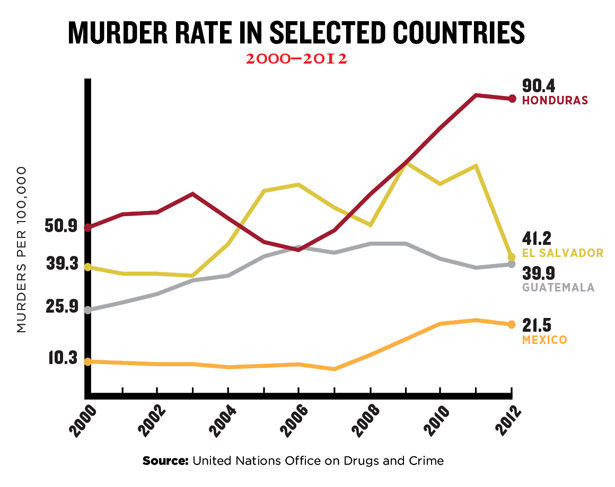
For those who remain behind, life can seem hopeless. According to the U.N. Office of Drugs and Crime, Honduras suffered an average of 90.4 homicides per 100,000 people in 2012. Or put it this way: On average, 20 people a day are murdered in the country sandwiched between El Salvador, Guatemala and Nicaragua.
By comparison, the United States had 4.7 murders per 100,000 in 2012 -- higher than almost every other developed country.
The figures are more distressing in Honduras' second-largest city, San Pedro Sula. It has a murder rate of 169 per 100,000 people. "In San Pedro Sula, people are mowed down on soccer fields, in shoe factories and at the airport," the Los Angeles Times wrote in December.

Fusion 

BOLD are my comments as I edit the article
The unprecedented rise in Honduran children fleeing to the U.S. is due to misinformation about American immigration laws and drug violence, the president of Honduras told Fusion on Friday.
“They might think they can gain legal status through this,” said President Juan Orlando Hernandez. “But on the other hand, this is a kind of displacement, because of the cartel wars and the Maras [gangs] in Central America.”
President Obama has called the influx of children an “urgent humanitarian situation"
but adds that
Still, the administration has stressed that children who enter the country illegally will be subject to immigration law and, potentially, deportation. (there's a reason immigrant's rights groups call Obama the "Deporter in Chief" as he recently passed 2 million deportations, and to compare, the US prison system holds 2.3 million)
Politics in DC as usual
Lawmakers in Washington have argued in recent weeks over what’s causing the surge in child migration. Republicans say the deferred action program, which allows young undocumented immigrants to live and work in the U.S., is tempting more people to cross illegally. Democrats say it’s crushing poverty and violence in Latin America.
Honduran President Juan Orlando Hernandez, for his part, recognized both factors. He pleaded for U.S. authorities to recognize the plight of migrants.
“I’ve asked the United States government to treat this matter with the utmost care from the humanitarian perspective,” he said. “They are kids in search of their parents and they have the complete right to be with their parents.”

Let's look at some of the history.....

The 2009 US Backed Coup

I first posted this on June 15 when the story was in the news.  On July 17 Democracy Now also looked back at the history leading up to the current crisis, and spoke about the 2009 coup as a major source of the current violence.

The Diane Rehm show on the other hand did not mention the coup as a central factor in the current crisis.

Despite discussing the "as well as dealing with the root causes of these problems in the countries themselves." There was no mention of the coup in 2009. Diane Rehm Show July 28 2014


AMY GOODMAN: Professor Frank, I wanted to go to this issue of U.S. responsibility and turn to former Honduran President Manuel Zelaya, who was ousted five years ago. We got a chance to sit down with him in 2011 at his home in Tegucigalpa. I had just flown in with him. This was after the coup when a new president was chosen. And his family flew back from Nicaragua to Honduras. It was the first time that he was at his home for several years.
MANUEL ZELAYA: [translated] The U.S. State Department has always denied, and they continue to deny, any ties with the coup d’état. Nevertheless, all of the proof incriminates the U.S. government. And all of the actions that were taken by the de facto regime, or the golpista regime, which are those who carried out the coup, and it is to make favor of the industrial policies and the military policies and the financial policies of the United States in Honduras.
AMY GOODMAN: That’s former Honduran President Manuel Zelaya. Professor Dana Frank, he strongly felt that the U.S. was involved with the coup. What evidence is there for that?

DANA FRANK: Well, the biggest evidence we have is that his plane stopped at the air force base at Palmerola, known as Soto Cano Air Force Base now, which is a joint U.S. and Honduran base. That plane could not have stopped there without U.S. permission. We don’t have the big smoking guns. We certainly have the behavior of the U.S. State Department and the White House after the coup, which was to legitimate the coup government as an equal partner to Zelaya—in fact, as a superior partner. They never denounced the spectacular repression after the coup. And they treated Zelaya like a bad child for trying to return to his own country. They recognized—they announced that they would recognize the outcome of the illegitimate November elections after that, even before the votes were counted. And it was clearly they wanted the whole situation to go away.


July 28, 2009 The Nation
What specifically did Zelaya do to conjure these malevolent spirits of the cold war past? The US press has focused on his efforts to build support for a constitutional assembly, misrepresenting the effort as a power grab when in fact the proposal to revise the Constitution was broadly supported by social movements as an effort to democratize Honduras's notoriously exclusive political system. The business community didn't like Zelaya because he raised the minimum wage. Conservative evangelicals and Catholics--including Opus Dei, a formidable presence in Honduras--detested him because he refused to ban the "morning-after" pill. The mining, hydroelectric and biofuel sector didn't like him because he didn't put state funds and land at their disposal. The law-and-order crowd hated him because he apologized on behalf of the state for a program of "social cleansing" that took place in the 1990s, which included the execution of street children and gang members. And the generals didn't like it when he tried to assert executive control over the military. Similar to the armed forces in Guatemala and El Salvador, the Honduran military after the cold war diversified its portfolio, with its officers investing heavily in both legitimate and illegitimate businesses, such as the narcotics trade, illegal logging, and illicit adoptions.

June 30, 2009 New York Times
The United States has a history of backing rival political factions and instigating coups in the region, and administration officials have found themselves on the defensive in recent days, dismissing repeated allegations by President Hugo Chávez of Venezuela that the C.I.A. may have had a hand in the president’s removal.
Obama administration officials said that they were surprised by the coup on Sunday. But they also said that they had been working for several weeks to try to head off a political crisis in Honduras as the confrontation between Mr. Zelaya and the military over his efforts to lift presidential term limits escalated.
The United States has long had strong ties to the Honduras military and helps train Honduran military forces. Those close ties have put the Obama administration in a difficult position, opening it up to accusations that it may have turned a blind eye to the pending coup. Administration officials strongly deny the charges, and Mr. Obama’s quick response to the Honduran president’s removal has differed sharply from the actions of the Bush administration, which in 2002 offered a rapid, tacit endorsement of a short-lived coup against Mr. Chávez.
Let's hope that media pays more attention to news in South America, and lawmakers tell the whole truth and really try to solve some issues. As long as the media only focuses on a part of the story this week, news reports will never show the causes and effects and how we got here.  That assumes they even try to cover the story in the first place.