Showing posts with label Police Shootings. Show all posts

Wednesday, August 26, 2015

Justice for Nate Wilks

Police shoot and kill someone every single day.  So far in 2015 there have only been nine days where that was not the case. Every day we have to learn about a new name, and details of what happened.  One recent name I heard was Nate Wilks. Police say he was an armed robbery suspect and during a chase turned towards cops and refused orders to drop gun. According to the family, eyewitnesses at the scene disagree and say he was simply running away from police.  Oakland police showed the video to reporters on the condition that they don't release it to the public (because that's how to regain our trust!)
Although some witnesses said Wilks raised the gun at the officers, the videos do not show him making such a move.
“Remember, a gun can be fired from any position,” [Lt. Roland] Holmgren said.
East Bay Express discusses California transparency laws with regards to when footage is shown
Oakland Police Department officials came under fire last week for showing police body-camera videos to a group of select journalists, while refusing to release the footage to the general public. First Amendment experts widely agreed that OPD's actions likely violated the California Public Records Act, and that, at minimum, the department should now show the videos, which involved the two recent deaths of local citizens, to anyone who wants to see them. And while those criticisms are valid, last week's video disclosures also raise numerous questions about how and when police departments will reveal video footage at a time when law enforcement agencies around the state are increasingly mandating that all cops use body cameras.
Rapid News Network adds
Body cameras also captured the deaths of two other men, Demouria Hogg and Antonio Clements, who have been shot and killed by police since June. Hogg was killed during a confrontation near Lake Merritt after police said he was found asleep in his auto with a loaded gun on the passenger seat.
The deadly shooting of 24-year-old Nate Wilks led to protests in the streets of Oakland. It also drew criticism from prominent civil rights attorneys upset that the department limited the viewing to select media members and refused to show footage of other men recently shot and killed by police. “They should not just be released when the shootings from a police point of view are justifiable”.
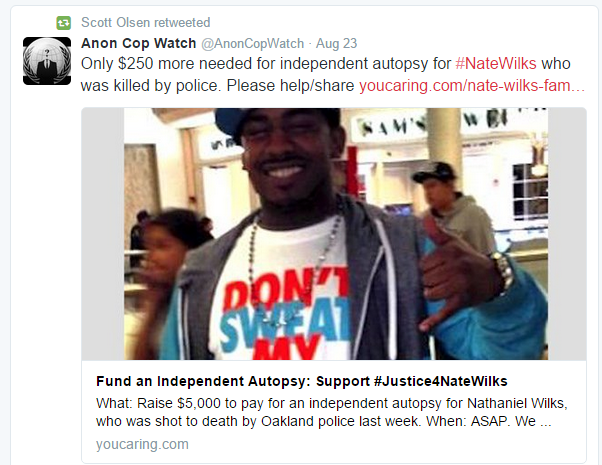
I was glad that the fundraiser for an independent autopsy reached it's goal.  I am also reaching out for more information on the case, since I have had trouble finding information after the fundraiser.  I am also trying unsuccessfully to find more information on Tyronne Harris, shot on the anniversary of the killing of Mike Brown


A second look at the autopsy of Mansur Ball-Bey shows why we need independent autopsies conducted in police shootings.

Mansur Ball-Bey, shot last week by police, suffered a severed spinal cord, officials disclosed Wednesday, leading to questions of whether such a wound would have permitted him to run a short distance, as officers have said.
Dr. Michael Graham, the medical examiner, arranged a re-examination of the body Wednesday and told a reporter that Ball-Bey’s spinal cord may have survived the impact but unraveled as he ran. In any event, the bullet also pierced his heart, which still would have been fatal.
Attorney Jermaine Wooten, who is representing Ball-Bey’s family, said the second examination at Graham’s office is “suspicious.”
“That’s a clear indication to me that given the initial results they learned from the initial autopsy, it doesn’t support the position the police laid out at first as it relates to Bey being shot and running, so they want to take a second look to modify those findings,” Wooten said. “These things should have been addressed early on and I don’t see why they are taking a second look when it should have been thorough and complete the first time.
Ball-Bey's family attorneys have said that he wasn't even in the house when it was raided.
Police have said Ball-Bey and a 14-year-old ran out the back door of the residence and encountered two officers in the alley. They say Ball-Bey pointed a stolen handgun with an extended magazine at one of them.
The second-story flat at 1243 Walton Avenue has a long, steep rear staircase that leads to a door secured with a board. From there, attorneys showed how Ball-Bey would have had to run across the backyard, hop a fence into the alley, then run through another nearby backyard to the south and down a gangway before collapsing from a single gunshot wound to the back.
“The police narration isn’t plausible at all,” Jermaine Wooten, an attorney for Ball-Bey’s family, said at the scene. “That’s a lot of running he would have had to do to get to this point.”
Ball-Bey’s cousins live at the residence, but they told attorneys he wasn’t at the home when police arrived. They said he was coming there from work at FedEx shortly before the shooting.


I was very excited to see that the goal was reached with 21 hours left to raise more funds


I also noticed that a Scott Olsen had donated $100.  I later confirmed that it was in fact Iraq War vet Scott Olsen injured by police at the Occupy Oakland protest


Friday, June 5, 2015

Amendment to CJS to reform police interactions with mentally ill like Dontre Hamilton

This is an excerpt from this larger post on the House CJS bill.  This post deals with Wisconsin Representative Gwen Moore's amendment to CJS regarding police interactions with the mentally ill like Dontre Hamilton 

Representative Gwen Moore spoke on the floor of the House yesterday about an amendment to CJS regarding the case of Dontre Hamilton and how police treat mentally ill citizens
Amendment Offered by Ms. Moore

Ms. MOORE. Mr. Chair, I have an amendment at the desk.

The Acting CHAIR. Is there objection to the gentlewoman offering the amendment at this point in the reading? There was no objection. The Acting CHAIR. The Clerk will report the amendment. The Clerk read as follows:

Page 34, line 19, after the dollar amount, insert ``(reduced by $2,000,000)''.
Page 42, line 24, after the dollar amount, insert ``(increased by $2,000,000)''.
Page 44, line 8, after the dollar amount, insert ``(increased by $2,000,000)''.

The Acting CHAIR. Pursuant to House Resolution 287, the gentlewoman from Wisconsin and a Member opposed each will control 5 minutes. The Chair recognizes the gentlewoman from Wisconsin.

Ms. MOORE. Mr. Chair, my amendment transfers $2 million into the Mentally Ill Offender Treatment and Crime Reduction Act for the purpose of expanding and improving police training to safely and appropriately respond to mentally ill individuals. Now, Mr. Chair, we have heard a lot lately in the news about high profile police-involved shootings that have become a major subject here around the country and here in Congress. Not surprising to some of us, especially those of us who hail from large urban cities, this is a widespread problem that has been around for a while. But today, I am offering this amendment to highlight one serious issue that I think should be a major part of our current national dialogue: ensuring that police have adequate training to identify persons with mental illness and to safely, when it is possible, resolve encounters during a crisis. Mr. Chair, indulge me for a moment while I tell you a story about a 31-year- old man in my home district of Milwaukee, Wisconsin, who, unfortunately, is no longer with us today. His name was Dontre Hamilton. Dontre, like many people in this country, suffered from a mental illness. He was diagnosed with schizophrenia 1 year prior to the incident and had been off his medication due to an insurance issue. On April 30 of last year, Dontre was taking a nap on a public park bench when employees of a nearby Starbucks called the police. Two police officers came and did a wellness check and left the scene, discerning that Mr. Hamilton was no threat to himself, nor to anyone in the park or the public. Soon thereafter, yet another call came from the Starbucks employee because this gentleman was sleeping on the public park bench. Another police officer, Officer Manney of the Milwaukee Police Department, arrived and started to pat down Dontre. This pat-down turned into a struggle, and Officer Manney pulled outhis baton to help him subdue Mr. Hamilton. The struggle escalated, and Dontre got control of the baton and swung it at Officer Manney. This caused Officer Manney to draw his firearm and shoot 14 bullets into Dontre Hamilton. Officer Manney was terminated for conducting a pat-down in contravention of his training on dealing with mentally ill individuals but faced no charges in the death of Dontre Hamilton. Mr. Chair, perhaps this tragedy could have been prevented. Too often, our mental health infrastructure is woefully inadequate for many Americans. A lack of treatment can turn a treatable mental illness into a severe debilitating condition. Many can't hold a job or pay rent. Many end up homeless on the streets. In fact, more than 124,000 of the 610,000 homeless people in the United States suffer from a severe mental illness. As a result of many failures in our system, our Nation's police officers have de facto become our country's first responders to crisis calls, including those individuals experiencing mental illness. Too often these calls, many intended to be out of concern for the individual in crisis, become a tragic fatality. As we know, mentally ill persons are not generally dangerous, Mr. Chair. In fact, they are actually more likely to become victims themselves than actual perpetrators of violence. Many of these tragic encounters could be prevented if police officers are trained and follow proper procedures. The Mentally Ill Offender Treatment and Crime Reduction Act is an important Federal initiative and tool that will help us bridge this gap. This law established a grant program called the Justice and Mental Health Collaboration Program which helps States and localities develop collaborative approaches to dealing with the intersection of criminal justice and mental health systems. One of the authorized grant uses under the program is training to police officers for exactly these purposes: to safely respond to crisis calls and limit the chance of a tragic and often preventable consequence. I yield back the balance of my time.

Mr. CULBERSON. Mr. Chairman, I claim the time in opposition, but I am not opposed to the amendment.

The Acting CHAIR (Mr. Woodall). Without objection, the gentleman from Texas is recognized for 5 minutes. There was no objection.

Mr. CULBERSON. The gentlewoman has a good amendment, and I want to encourage Members to support it. I yield back the balance of my time.

The Acting CHAIR. The question is on the amendment offered by the gentlewoman from Wisconsin (Ms. Moore).

The amendment was agreed to.


Friday, March 27, 2015

Some Documents on Police Shootings and Brutality

Documents on Police Shootings and Brutality

DOJ Report on Michael Brown Shooting
DOJ Report Pattern and Practices Chart
President's Task Force on 21st Century Policing Interim Report March 2015
Sentencing Project Report Black Lives Matter: eliminating racial inequity in the criminal justice system
DOJ report Civil Rights Division accomplishments in 2013
DOJ Report Civil Rights Division 2009-2012
Every 28 Hours Report by Operation Ghetto Storm

2012 Annual Report on the extrajudicial killing of 313 Black people by police, security guards and vigilantes

The Report exposes how every 28 hours someone inside the United States, employed or protected by the U.S. government kills a Black child, woman or man.

clarifying what the report actually says
On August 20, in one of those debates that corporate media set up more for entertainment than for enlightenment, CNN pitted right-wing Black pundit, Larry Elder against liberal Black commentator Marc Lamont Hill.  Lamont attempted explain that the killing of “unarmed Black youth Michael Brown” was part of a pattern. Elder interrupted and demanded to change the subject to “Black-on-Black” violence. In an exchange, now partially deleted from CNN’s website, Elder accused Hill, “You don’t even know how many Black people are killed by police.”
“Yes we do know,” Hill proclaimed, “Every 28 hours an unarmed Black person is killed,” and he cited the Report. Unfortunately for Hill, neither the hashtag, nor the Report, distinguished between “armed” or “unarmed”. It counted the total.

Wednesday, December 24, 2014

A Not So Merry Christmas in Ferguson

Another day, another unarmed black man, Antonio Martin, shot by police, again in Ferguson, making this at least 4 since August (Mike Brown, Kajieme Powell, Vonderrit Myers and now Antonio Martin), and as I document here, 10 police shootings before Mike Brown that didn't provoke national outrage.

And as we await the grand jury decision (to not indict the police who killed) Akai Gurley, we see another grand jury in Houston clear a police officer who shot an unarmed black man, Jordan Baker.
A Harris County grand jury today has cleared a Houston police officer in the fatal shooting of an unarmed man in January.
The panel, which has been meeting for months, cleared officer Juventino Castro in the death of 26-year-old Jordan Baker.
We are seeing an ugly trend.  Darren Wilson cleared, Daniel Pantaleo cleared.

I included this article in my post discussing Ferguson before Mike Brown brought national attention to Ferguson and reignited the discussion of police violence.
Two police shootings in Granite City justified, grand jury says
September 05, 2014 11:30 pm • FROM STAFF REPORTS
St. Charles man killed by Granite City officers responding to his 911 call
Officers said they feared for their lives when the man pointed a gun at them. Read more
Police: Man who attacked mother with baseball bat, was shot by Granite City police is charged
He hit mother, another relative with baseball bat. Read more
GRANITE CITY • Two officer-involved shootings here earlier this year — one fatal and one not — were justified, according to Madison County grand jury findings released Friday.
Yes we also mourn NYPD officers Wenjian Liu and Rafael Ramos.  We mourn any and every violent unnatural death.  We condemn vigilantism and murder when it comes from criminals shooting cops, or gang members shooting each other or hitting innocent bystanders, and we condemn police who shoot unarmed civilians the second they arrive on the scene such as with Tamir Rice, Akai Gurley and others.

I was glad to see that NYPD is expanding the use of TASERS, but that is a small step in changing a much larger issue of the current culture.

The murders of Wenjian Liu and Rafael Ramos cannot be compared to those killed by police, if for no other reason then those who are not police are almost always punished for their actions.

According to a 2010 study by Harvard University on police-on-police shootings
Since 1981, some 26 police officers across the United States have been shot and killed by fellow police officers who have mistaken them for dangerous criminals. These fatal shootings are doubly tragic, first because both the shooters and victims in such situations are risking their lives to enforce the law and protect the public, and second because many of these deaths are preventable. The dangers that give rise to these deaths are inherent in policing, but those dangers can be reduced and more deaths prevented.
Over the last fifteen years, ten of the fourteen officers killed in these mistaken-identity, police-on-police shootings have been people of color.
Kevin Gosztola updates the list from there, and echoes my explanation on the difference between those who kill cops and those who are killed by cops
In 2014, 46 police officers have been killed by gunfire, according to Officer Down Memorial Page which tallies “fallen law enforcement heroes.” Three officers died from being struck by vehicles, five officers died while pursuing vehicles and ten officers died from “vehicular assault.”
By comparison, according to Killed by Police, which keeps track of reports of instances where police shoot and kill suspects, well over 1,000 people have been killed by police this year.
While there are potentially more vigilantes out there who may seek to execute police officers, there is no systemic problem with holding vigilantes who seek revenge against cops accountable for their crimes. There are systemic problems with how the American justice system is setup in ways that make it possible for killer cops to escape justice.
Linda Sarsour wrote very movingly on her blog, saying
We need to move together but before we do that - we need to listen to one another.
I find it ironic how we want to demonize an entire movement that's mantra is‪#‎BlackLivesMatter‬, a movement in which the sanctity of life, the value of life including Black life is at its very core. I find it ironic that the very same people will say don't judge an entire political party, or faith community, or group of people by the despicable acts of a few - then are quick to blame hundreds of thousands of peaceful protesters for the acts of a few. This movement has never been about revenge or vendettas, its always been about love. I have never felt more love in social justice movements than I have felt this year.
People will say well why not then say ‪#‎AllLivesMatter‬, and I will say it is not all lives who have to justify their value and why they matter. It is not all life that has to prove why they don't deserve to be treated as sub-human. We as a society have decided who matters and who doesn't and we have proved it in the way the system works or doesn't work, who it oppresses, which countries we choose to wage war with and the increase and nonchalant usage of the word "collateral damage."
As Officers Liu and Ramos are laid to rest, leaving behind loved ones, and how difficult it must be for them that we must also remember there are families who go to bed every night without their loved ones who are also lost to senseless violence, including police violence. Sisters and brothers, we can mourn the death OF police and BY police. They are not mutually exclusive. Whether you are a doctor, lawyer, taxi-cab driver, cashier, street vendor or police officer - ALL lives matter. I will not engage in selective outrage over murders of innocent people. We should be calling each other to a higher moral ground - not engage in a divisive, toxic downward spinning cycle which creates more hate and animosity. This will not help us move closer to a better city, a better country or a better world.
I respect this time, the funerals and families of Ramos and Liu, but asking Black Americans and communities of color to "stop protesting" indefinitely is unreasonable. To engage in requests to elected officials to suppress the constitutional rights of segments of the American population makes you no better then the countries we are quick to criticize for lack of democracy. We have waged wars on countries in the Middle East and forced democracies down their throats meanwhile we are calling for the suppression of free speech and freedom of assembly right here in the United States.
We need to work hard to stop the violence, but it can be done.  The goal is to make this list stop growing.  So far we have not achieved that goal as more have fallen since August.  But it's only been 138 days.  The fight continues.


Thursday, November 13, 2014

Governor Nixon gets it wrong

People have the right to express views and grievances, but they do not have the right to put fellow citizens and property at risk,” Nixon said, while explaining how the National Guard is part of his contingency plan to protect his officers.
“Violence will not be tolerated.” he continued.
In his press conference there was not one mention of Michael Brown, VonDerrit Myers, or Kajieme Powell.

continued
The powerful message quickly morphed into a hashtag- #ViolenceWillNotBeTolerated, and an impromptu twitter campaign ensued, reminding the Governor, and anyone who forgot- of the militarized police presence and violence that he signed off on when his storm troopers declared war on demonstrators.
continued 
The Governor received 33,549 tweets on Tuesday- the hashtag was used 7,268 times by midnight.
Governor Jay Nixon's press conference regarding the impending grand jury decision gets the situation wrong. Governor Nixon is preparing the police force for violence expecting it to come from the protesters; now while there have been a few cases of violence from the protesters or those taking advantage of the protests to be violent, Governor Nixon is ignoring the police violence against unarmed black men before the killing of Mike Brown, and the violence against peaceful protesters perpetrated by his cops since protests erupted after the death of Mike Brown, even as this week Mike Brown's parents (video below) are at the UN Committee against Torture hearing in Geneva discussing police violence (video below).


(This video no longer exists)


Here are some of tweets documenting police violence


When I saw the press conference and hashtag my reaction was to flip it on its head as Governor Nixon continues to shift the blame from trigger-happy cops attacking unarmed black men to the peaceful protesters back to the reason there have been peaceful protests in Ferguson since August, and even before Mike Brown was killed and the news media started deciding to pay attention.

Governor Nixon got it wrong.  When he said that violence will not be tolerated, he didn't clarify by whom.  He meant violence from protesters will not be tolerated.  I agree with that sentiment.  Those who have been in Ferguson since August agree with that sentiment.  But the issue with that statement is that except for a few minor exceptions over 3 months, a vast majority of protesters have been peaceful, while they are attacked by police and 2 more black men have been killed by police in Ferguson, Kajieme Powell and Vonderrit Myers.  The protesters are peaceful, the cops are not.  When stating that violence will not be tolerated, let's tell the truth about who is violent.

Let's tell the truth that what Governor Nixon is saying is that violence from protesters will not be tolerated but violence by police is somehow justified.  And then let's change the statement to what we need to address the real issues.

Let's change the derogatory #ViolenceWillNotBeTolerated to the more realistic ideal that would actually bring change to Ferguson, and remind those in charge that one day we hope that #PoliceViolenceWillNotBeTolerated

Wednesday, October 29, 2014

The Strange Case of DaMonte Shipp (aka Ceebo), Cousin of Ezell Ford

I am reposting this story here. See original here.  (I couldn't embed media because it messed up the rest of the article's format, but I put the links in their places.)


Identified by Shade of Skin & Handcuffs, Ceebo Tha Rapper Facing 4-24 Years in Prison

by Alissa Kokkins
October 29, 2014
Ceebo-Tha-Rapper-son
Ceebo Tha Rapper with his son
“Mass incarceration on a scale almost unexampled in human history is a fundamental fact of our country today — perhaps the fundamental fact, as slavery was the fundamental fact of 1850. In truth, there are more black men in the grip of the criminal-justice system — in prison, on probation, or on parole — than were in slavery then. Over all, there are now more people under ‘correctional supervision’ in America — more than six million — than were in the Gulag Archipelago under Stalin at its height.” — Adam Gopnik, “The Caging of America”
(TheAntiMedia) POMONA, CA – On September 25th, 2013, DaMonte Marquise Shipp Sr., 22, aka Ceebo Tha Rapper was pulled out of the back of a cop car in handcuffs. Two houses had been robbed nearby. Two witnesses, a mother and son, were brought on the scene and asked if Ceebo was the African American man they had seen through the window running and hopping a fence with a light skinned man 40 feet from their house. Ceebo had been detained and arrested by police miles away in an apartment complex. On the stand, both witnesses would testify that they identified Ceebo by skin tone, clothing, and even handcuffs.
This was all witnessed in a matter of seconds through two different windows in the same house: one upstairs and one downstairs. The son testified that the African American man was wearing a white t-shirt, the mother said a white baseball jacket. However, Ceebo was wearing a black shirt on that day. One of three defendants in the case, Ceebo and his codefendant, Andrew Lopez, were identified in a popular practice known as a field ID. Unlike the line ups cop characters perform on television, field ID’s essentially constitute a police officer bringing the witness into the field where they tell the witness that they should not be biased just because they see the suspect in custody or handcuffs. Police then show their suspect to the witness. All in the good grace of faith and non bias, the witness then says yes this is the one I saw or no. A quick shortcut for cops, field identifications are a dangerous practice that that threaten to bring frequently criminalized black and brown youth that much further from justice and closer to becoming a statistic.
When recounting their field ID neither mother nor son recalled the officer reading the field admonishment card which goes something like this:davis-field-admon
Neither witnesses, prints nor anything aside from the field ID placed Ceebo or Lopez in the neighborhood let alone inside either house. However,  by proximity, and in Ceebo’s case, identification by shade of skin, both defendants were found guilty… and not guilty. The jury that had taken three hours to decide the next half decade to two decades or so of Ceebo and Lopez’s lives, filled out paperwork for both a guilty and not guilty verdict. No one knows for sure how that happened, but I have my own suspicions. California jurors are compensated $15 per day (while police officers are often paid time and a half to testify as “expert witnesses”). Who cares about getting it right when you want to get out of there?
police-paid-to-go-to-courtIn the end the jury tossed their not guilty paperwork and came back with a win i.e. financial windfall for the state, guilty on both counts of first degree residential burglary. Despite there being no violence and the only material loss being a broken sliding glass door, Ceebo Tha Rapper faces 4, 8 or 12 years minimum for each count or something like that. Since the verdict, I have not been able to reach his lawyer and even his family does not know exactly how much time Ceebo is facing. Uncertainty, lack of security, threat of violence and the absence of caring is part of America’s prison system experience. For everyone involved, including his family. Lopez faces a minimum of two years and maximum of seven+ years.
Each malnourished year Ceebo serves will costs California taxpayers an average of $63,000. More expensive than Harvard but with the only promise prison holds being that of turning out hardened criminals and the nearly unemployable, prison is a profitable tradeoff compared to restorative justice like replacing broken glass. With each inmate costing $63,000 per year, one would think funds would at least be allocated to limit discrimination, save taxpayers money and secure more lineups for beyond a reasonable doubt identification practices. But nah, that simply would not be profitable for the state.
California-Prisoner-costQuite likely unbeknownst to the 48+ people who were paid to persecute, serve and/or give witness testimony in this case, Ceebo tha Rapper, is and is not just another young black man from South Los Angeles that the state put in prison. A father to three boys and one of twenty-one brothers and sisters, Ceebo is a dedicated family man. After the death of his cousin, Ezell Ford, Ceebo became a community organizer in Los Angeles and has been organizing rallies and marches for Tha Movement for Ford, demanding for justice for Ezell Ford and all victims of police violence. A rising young leader and artist, Ceebo also released songs and music videos promoting unity amongst all people and an end to police violence. During his own trial, Ceebo’s evenings were spent in the studio working on “They Don’t Care About Us,” a single he would release only days before he was led out of the courtroom in handcuffs. A haunting song considering what was to come.
(watch the video here--BiasedReporter)
Admired and adored by both friends and strangers, the young black rapper was also feared by LAPD. Not for crimes but due to the power of Ceebo’s rhymes and organizing. After the release of his “Fuck Tha Police” video in response to the killing of Ezell Ford, Ceebo was publicly persecuted and criminalized by police in the mainstream media. While Ceebo’s personal journey from the streets of South LA to rapper and activist are that of the extraordinary, Ceebo’s personal struggle from the death of a cousin to his own imprisonment is too common. As a black youth, his recent conviction sadly brings Ceebo full circle through the school to prison pipeline. A course that promises a high chance of early death and/or imprisonment for those who are black and poor. Familiar tragedies that young Ceebo himself touched on in his revolutionary rhymes:
I’m tired of seeing people broke,
tired of seeing funerals
they don’t want to see us grow
I’m trying to let my people know.
Protest Organizer, Ceebo Tha Rapper, @ Newton Police Station
However, according to the light skinned district attorney’s logic, Ceebo would only be running from police officers as an implication of guilt and nothing else. A district attorney who began the case by stacking all the odds against Ceebo.
(embedded tweet here--BiasedReporter)
If race dynamics in Los Angeles are anything like they are in Florida, before anyone testified on the stand, the state had an 81% chance of convicting Ceebo the minute the District Attorney eliminated all black jurors from the jury pool. Throughout the trial one of two alternate jurors, a lone black man in the corner of the jury box, constantly glanced at Ceebo. Had him or one black person had a voice in Ceebo’s case, Ceebo’s odds of conviction would have dropped to 71%. And the minute Ceebo came out of his mother’s womb, he had a 33% chance of going to jail according to the an August 2013 Sentencing Project report on Racial Disparities in the United States Criminal Justice System, that was submitted to the United Nations.
“One of every three black American males born today can expect to go to prison in his lifetime.” - Racial Disparities in the United States Criminal Justice System
Ceebo-Movement_Ford
“He did everything he could before they locked him up… He had enough time to leave that imprint and I think he feels good about that. They ain’t going to break him down.” – Mason Knight 333, Ceebo’s Director & YouTuber
Despite Ceebo having discipline and dedication in the wake of the police killing of his cousin while advocating the exercising of rights to fight for justice, his bail was exonerated by Judge George Genesta and Ceebo was immediately detained. Upon hearing the news, Ceebo hung his head like it was in a noose… because now it is. Courtrooms host modern day lynchings for men of color. Next Ceebo will be given his “bid” i.e. sentencing into a prison system that is almost guaranteed to fail him. All paid for by your tax dollars.  Right now, the odds remain stacked against Ceebo. As a young black man, Ceebo faces a hasher sentence than white counterparts according to a comprehensive survey of 40 studies covering 30 years of sentencing outcomes at both the state and federal by Professor Cassia Spohn -
“Although it is irrefutable that the primary determinants of sentencing decisions are the seriousness of the offense and the offender’s prior criminal record, race/ethnicity and other legally irrelevant offender characteristics also play a role. Black and Hispanic offenders—and particularly those who are young, male, or unemployed—are more likely than their white counterparts to be sentenced to prison; they also may receive longer sentences than similarly situated white offenders. Other categories of racial minorities— those convicted of drug offenses, those who victimize whites, those who accumulate more serious prior criminal records, or those who refuse to plead guilty or are unable to secure pretrial release—also may be singled out for more punitive treatment.”
One of the last things Ceebo spoke about on his last day as a free man was the importance of people who care serving on juries.  Part of the reason the prison industrial system thrives is because the public is not present and participating. We need to change that. We need to serve on juries and pack the courthouses to support people facing time, if we are afforded the privilege to do so. It helps hold the system, courts and juries accountable for their practices and conduct. Not to mention that it shows those facing time that their lives matter. The decision to strip them of their and their children’s futures matter. Children matter. Your time matters. #BlackLivesMatter
The odds stacked against Ceebo may be alleviated with your support. To help #freeCeebo aka DaMonte Marquise Shipp Sr., please send letters pleading for leniency for from the judge for “DaMonte Marquise Shipp Sr.” to freeCeebo@gmail.com. Ceebo’s sentencing is November 20th @ 8:30am at Pomona Courthouse. Please join Ceebo’s loved ones, fans and supporters on 11/20/14 and Let’s Pack the Court! Court Support for @CeeboThaRapper. To donate to Ceebo’s criminal defense fund, click the donate button below. 
(click to donate here--BiasedReporter)

The thing is with people nowadays, they don’t feel the pain of others until that pain is brought to them. Well, we’re here because that pain has been brought to us. We feel that pain every day …and I’m here to let you all know what that pain is like before it is brought to you directly. – Ceebo Tha Rapper


This article is free and open source. You have permission to republish this article under a Creative Commons license with attribution to the author and TheAntiMedia.org. Follow us on Facebook and Twitter to receive our latest articles.

Thursday, October 23, 2014

Other Missouri Police Shootings before Mike Brown

I want to take a look at Ferguson before it became a national story.  I find it important to go back and see what was happening before the media shines a spotlight on a situation, and what happens after the spotlight goes somewhere else (some examples include natural disasters like Haiti's earthquake and include wars like Libya, which haven't ended even though US media has left.  See here for 2013 examples and here for 2010).

The St. Louis Post-Dispatch put together a great map (of an awful topic) documenting homicides as of October 21 2014 (not all of them are shootings, but lists some beatings, stabbings, arson as well)

This map gives details on homicides in the St. Louis area in 2014. 
KEY:
Yellow: St. Louis city murders.
Red: St. Charles, Jefferson and St. Louis County murders.
Light blue: Metro East murders.
Purple: Murders the Post-Dispatch covered despite them having occurred on fringe or outside of newspaper's coverage area.
Green: Homicides ruled to be justified.
Brown: Fatal shootings by police.


I counted 199 homicides listed on the map as of October 21. (see blog post here)

Violence was an issue before Mike Brown was killed.  There were police shootings, criminal shootings, community vigils against violence, all before the media arrived.

NOTE: the above map lists only homicides, but articles below are A) edited by me and B) not all shootings lead to death and therefore are not listed above.  I am only documenting police shootings below.

1) December 19, 2013 St. Louis police chief calls for FBI probe into officer-involved shooting
ST. LOUIS • Fact: Cary Ball was a convicted felon carrying a loaded gun about 9:45 p.m. April 24.
Fact: Ball, 25, fled from St. Louis police, crashed a car at Cole and Ninth streets near the Edward Jones Dome and ran.
Fact: Ball died after two St. Louis police officers shot him 21 times at Eighth and Carr streets.
Unknown: Why did the observations of multiple witnesses conflict with each other and the officers’ account?
Investigators interviewed about a dozen people, with about half saying they saw at least part of the shooting.
continued
But no civilian witness reported seeing Ball point the gun at the officers. There is no video of what happened.
The department’s investigation concluded Nov. 15 that the officers were justified in killing Ball after he pointed a .40 caliber Glock at them.
continued
in a rare move, Police Chief Sam Dotson has requested that the FBI review his department’s handling of the case. He also met with Ball’s mother, Toni Taylor, and gave her a copy of the police report.
“Some paths are very clear to me, and with this one, I want to make certain that we are right,” Dotson said in a recent interview.
Finishing his first year as chief, Dotson said he had never made this kind of request before and believed it had happened only a few times in the department’s history.
continued
Taylor clings to a certificate her son earned before his death as proof that he had turned his life around. It declares Ball an “Emerging Scholar” at Forest Park Community College, because of his 3.86 grade-point average.
The day he was supposed to receive the certificate, he was buried. 
2) February 12, 2014 Police Shooting
ST. LOUIS • Police shot and killed a man they said pointed a gun at them earlier today near Calvary Cemetery. The man was identified tonight as Stephon Averyhart, 27.
continued
They came around a corner and saw the man pointing his gun at them. Two officers, "in fear of their safety" opened fire, according to a police department account of the incident.
The man was hit in the head. He was alive when taken to the hospital, died from his injuries, police said.
Police recovered a gun and narcotics from the scene.
The officers were not injured. The department identified them as a 35-year-old officer with 10½ years on the force and a 32-year-old officer with eight years on the force. The officers were placed on administrative leave, as is department policy in officer-involved shootings.

3) February 13, 2014 Police Shooting
JENNINGS • A 39-year-old Jennings man who was shot by St. Louis County police has been criminally charged after police say he fired at them Wednesday during an undercover drug investigation.
continued
Three officers then converged on the drug deal wearing badges and vests identifying them as police officers and tried to arrest George, when he drew a pistol from his waistband and pointed it at them. The officers then chased George on foot before George opened fire on them, according to the documents.
Officers then returned fire, striking George, who was then taken to a local hospital where he was treated for his injuries and is currently in stable condition, police said.
Police recovered about 56 grams of marijuana and a gun from George.
4) February 13, 2014 Police Shooting
ST. LOUIS • A man who robbed a convenience store next to a St. Louis police substation was shot by police after a brief car and foot chase Thursday evening, police said.
No officers were hurt, and the suspect, in his early 20s, was shot at least twice and was in stable condition at a hospital, said St. Louis Police Captain Michael Sack.
continued
Another police car was on the scene for an unrelated call.  The suspect saw that police car and got out of his vehicle and ran, flourishing a gun and turning towards officers, Sack said.  Three of the four officers at the scene fired shots and the suspect fired back, hitting him in the hip, thigh, back and hand.
Police recovered the gun as well as cash believed to be stolen from the store, Sack said.  
This is the third officer-involved shooting in the St. Louis area in two days. On Wednesday, St. Louis police said they fatally shot Stephen Averyhart, 27, after he pointed a gun at them during a chase.
On Wednesday night, St. Louis County detectives shot a man in Jennings during a drug investigation. Police opened fire on Brothel George, 39, after they said he pointed a handgun at them. He was in stable condition Thursday.
"It's a situation not created by our officers," Sack said. "The officers certainly have a right to defend themselves, as well as protect the citizens of the neighborhood. It's a dangerous job."
April 17, 2014 Murder charge filed against accomplice of robber killed by St. Louis County police (yes that's right, he was charged with murder after police shot his accomplice after a robbery)


Jabari Quarles, of St. Louis, was charged with murder after his alleged accomplice in a robbery was fatally shot by police.


FENTON • Police say Claudell Webb Jr. and Jabari A. Quarles tied up two workers inside a Fenton check cashing store Wednesday morning during a robbery before one of the fleeing robbers pointed a gun at St. Louis County police officers and was fatally shot.
Webb, 23, of the 200 block of Meadowcrest Drive in Ferguson, was shot in the chest and was pronounced dead at a hospital shortly after the shooting, police said.
continued
Police said the robbers showed weapons, tied up two store workers inside the store and took cash and car keys. Court documents say the suspects were confronted by arriving St. Louis County officers outside the store when Webb pulled out a Tec-9 with an extended clip holding 30 rounds.
During a struggle with police, an officer shot Webb once in the chest, killing him, police said. Police recovered Webb's gun at the scene.
Quarles surrendered peacefully, police said.
5) April 17, 2014 Police Shooting
ST. CHARLES • A 52-year-old man was shot and killed by a St. Charles police officer Wednesday night, police say.
continued
Witnesses told police that the man, who has been identified as Martin G. Brown, was threatening neighbors.  He had set off fireworks, which caused a fire, police said.
When officers arrived on scene, Brown began threatening them with a knife and a handgun.  Police tried to negotiate with the man, telling him to drop the weapons. When he did not comply, officers used a Taser on Brown, but it was ineffective.
Brown continued to threaten the officers and moved toward them with the weapons, and an officer shot him.
Brown was transported to a hospital where he was pronounced dead. No officers were injured.
The police officer who shot Brown was a 13-year veteran; he was placed on administrative leave pending further investigation.
6) April 30, 2014 Police shooting
(KMOV.com) – Police say two suspects are in custody after an officer shot one of them following a robbery at a north St. Louis McDonald’s restaurant Wednesday night.
According to police, a 21-year-old man was armed with a gun when he held up the McDonald’s restaurant.
continued
Witnesses told police the suspect jumped over a fence behind a nearby business. Officers responded to the 4900 block of San Francisco, where they found the suspect running west with a gun in his hand.
The officers chased the suspect, who turned around and pointed a gun towards them. The suspect refused to drop his weapon and officers opened fire, hitting the suspect several times. He was taken to the hospital in serious condition. His gun, two fully loaded magazine clips and money was recovered.
June 3, 2014 Police brutality, filming the police
ST. CHARLES • A man who said he used his iPhone to record St. Charles police interacting with an upset woman has filed a civil rights lawsuit claiming that officers illegally detained and assaulted him, and erased the video from his phone.
continued
The American Civil Liberties Union filed the case Tuesday in U.S. District Court in St. Louis on behalf of Kyle Hamilton, 26, formerly of St. Charles. It seeks unspecified financial damages and costs of the suit.
Hamilton, who now lives in New York, alleges that St. Charles and two officers identified in court documents only as “John Doe” and “Jane Roe” violated his rights on Aug. 16, 2013, as he stood with friends on a public sidewalk along Main Street.
“It’s a situation where I know the law and I wish — I would hope — that those that enforce the law are also aware of it,” Hamilton said in an interview Tuesday.
He said he started recording after observing a St. Charles officer chase after a woman on Main Street and push her to the pavement.
continued
One of the officers, on horseback, saw Hamilton recording and grabbed him by his shirt collar, “choking him, bruising his neck and ripping his shirt,” the suit says.
7) July, 5, 2014 Police Shooting
ST. LOUIS COUNTY • A Pine Lawn police officer fatally shot a man who fled after a traffic stop and then struggled with the officer, St. Louis County Police said Saturday.
Police have not released the name of the man who died. (BiasedReporter's note: He was ID'ed here on July 7)
County Police detectives are handling the investigation of the shooting that happened about 3 a.m. near Interstates 170 and 70.
St. Louis County Police Sgt. Colby Dolly gave this account of what happened:
The incident started in Pine Lawn with a traffic stop along westbound Interstate 70 and Jennings Station Road. After police stopped a car with a wanted person alert on the license plate, the car prematurely left the scene and a Pine Lawn officer pursued the car until it crashed on Interstate 170 at the Interstate 70 interchange.
The driver then ran with and the officer ran after him, Dolly said. The officer was able to catch the driver and a struggle ensued when the officer tried to take him in custody. During the struggle, the officer shot the driver.
8) July 9, 2014 Police Shooting
A St. Charles man who called 911 early this morning insisting police show up at a Granite City gas station was fatally shot by the arriving officers who say the man pointed a gun at them.
"The individual calling was obviously distraught and requested police for an unknown reason," said Master Sgt. Mark Doiron with the Illinois State Police.
Police arrived at the Phillips 66 station, at 3215 Edwardsville Road, shortly after the 4:12 a.m. emergency call came in. Two officers found Stephen S. Minch, 45, sitting in his vehicle, parked behind the station.
"They pulled up not really knowing what they had, and one of the officers saw that the suspect had a pistol," said Doiron. "They ordered him to drop it several times and he began raising it in the direction of the officers."
Concerned for their safety, the officers shot Minch multiple times and he died at the scene, Doiron said. The officers were not injured, and the gas station was not open at the time.
Illinois State Police took over the investigation since the shootings involved two officers with Granite City Police, the agency that first responded.
July 25, 2014 Black cop who broke man's fingers was arrested, charged, unlike Darren Wilson (via Blog Post on Metrolink contract)


Dawon Gore, a St. Louis County police officer, was charged with assault after allegedly hitting a man with his baton without cause.


A veteran St. Louis County police officer was arrested Friday morning and charged with assault for allegedly using his baton to hit a man in the hand after an argument in April while he was working security for MetroLink.
Dawon Gore, who has been on the St. Louis County police force 13 years, was charged with second-degree assault. Bail was set at $3,500, cash-only.
continued
Gore hit Wilson so hard, court documents allege, that Wilson suffered three broken fingers and required surgery.
Gore took Wilson into the MetroLink platform office, held him there for 90 minutes and refused to get medical attention for him, Belmar said. Then, Gore took him home.
Gore didn’t tell his supervisor about the incident or write a police report, Belmar said.
again see difference compared to Darren Wilson, "Authorities said they won’t release the video to reporters because it is evidence in the case"
“This alleged unprovoked use of force outside the bounds of department policy and without cause cannot be tolerated,” the chief said.
Second-degree assault is a felony in Missouri, punishable by up to seven years in prison and a $5,000 fine.
Video surveillance and information from witnesses helped make the case against Gore, authorities say. Authorities said they won’t release the video to reporters because it is evidence in the case. The video showed Gore and Wilson on the platform, but the alleged attack took place out of the view of the camera, authorities say.
See interview with Dawon Gore here (interviewed by Cassandra)

From the interview

Officer Darren Wilson is White, I am a Black Officer. Wilson didn’t do a report, I also chose not to do a report. Both subjects were black males, Wilson’s subject had cigars but was unarmed and my subject was found not to be armed as well. Wilson drew a weapon (gun), and I drew my metal baton.
9, 10) September 5, 2014 Two police shootings in Granite City justified, grand jury says
GRANITE CITY • Two officer-involved shootings here earlier this year — one fatal and one not — were justified, according to Madison County grand jury findings released Friday.
In one case, Officers Timothy Bedard and Ryan Jones fatally shot Stephen S. Minch, 45, of St. Charles, on July 9, officials said. Minch had pointed a gun at them from a car and refused to put it down, according to a statement from State’s Attorney Tom Gibbons.
Officials said Minch called 911 to call officers to the Easy Stop service station, 3215 Edwardsville Road, about 4:12 a.m. on July 9. Investigators said police believed Minch was distraught.
The report of the grand jury’s unanimous vote noted that under Illinois law, an officer can use deadly force “when he reasonably believes that such force is necessary to prevent death or great bodily harm to himself or such other person.”
In the other instance, about 2:42 p.m. on Aug. 2, Officer Jason Schaefer wounded Thomas E. Noser, 52, with two shots in an encounter at 2444 Delmar Avenue when Noser refused orders to drop a knife. Noser had just used a baseball bat to beat his mother, 76, and another relative, a man, 38, officials claimed.
Noser is charged with attempted first-degree murder, aggravated assault and aggravated domestic battery.

Wrongful Arrests
April 26, 2014

jail records obtained by the newspaper last week show that police and jailers knew within nine days that they had arrested and incarcerated Jones on another man’s warrant. Yet they continued to hold him for two months more.
continued
Jones was one of about 100 men and women identified in a Post-Dispatch investigation to have been jailed by mistake in the city in recent years, some of them for months.
continued
Jones was arrested Nov. 7, 2009 (continued) He also was booked as Mark Crumble, who was wanted for violating probation, on the assumption that he might have been Crumble using Jones as an alias.
In a deposition, Jones said it marked the second time that night, and the third time in a week, that authorities mistook him for Crumble. The first two times he was released.
Jones said he and Crumble look nothing alike. “He had a big face and looked totally different from me. The only thing that was the same was the skin color,” he told lawyers.
He claimed a police officer once told him, “You all look alike.”

Mentally Ill
April 8, 2014

There were three community protests (from December 2013 to May 2014) against criminal gun violence ("black on black crime"), one is an annual vigil that is 22 years old.


Community leaders, clergy, politicians speak out against gun violence (that media usually ignores)
December 31, 2013
The vigil, the 22nd Annual New Year’s Eve Candlelight Service, was again held at Williams Temple Church of God in Christ, 1500 Union Boulevard.
The event was begun by Jeanette Culpepper, whose son was murdered 22 years ago.
continued
The crowd included parents, siblings, grandparents and friends of those who had died violent deaths in 2013 or previous years. Also in attendance were police officers, clergy, judges, aldermen and representatives of community groups.
The event included the reading of the names by candlelight of everyone who died by violence in the city — 120 in 2013, seven more than 2012 — and 20 in St. Louis County in 2013. Victims included infants and the elderly.
St. Louis Mayor Francis Slay began his remarks by recalling city’s 119th victim this year, Clara Jean Walker, who was inside her home Sunday when she was killed by a stray bullet that rocketed through a window.
“It’s a tragedy that never should have happened,” Slay said. “All of us should pledge to do everything we can to reduce the senseless shooting and violence. That includes telling police anything and everything we know about the person or people who were on Ms. Walker’s street” or in any crime.
“St. Louis is awash with guns,” the mayor said. “This has got to stop.” Of the 120 murdered in the city in 2013, 98 were men. At least 105 were African-American.
St. Louis Police Chief Sam Dotson and St. Louis County Police Chief Tim Fitch also addressed the crowd, pledging to do all they could. They acknowledged the tremendous toll violence has taken on area families.
continued
Senior U.S. District Judge E. Richard Webber told the families that all would have to work together to “break the endless cycle of hopelessness and helplessness.”
April 16, 2014
ST. LOUIS • Inside the sanctuary of Lane Tabernacle CME Church in north St. Louis’ Vandeventer neighborhood, people prayed and lit candles Wednesday night for those who died this year by gun violence. Some died blocks away; others, hundreds of miles away.
“We stand tonight, we pray tonight, and we are in solidarity tonight because we know there is a better way,” said the Rev. James T. Morris, the pastor of the church.
He invited members of the Central Reform Congregation in the Central West End to attend the church’s Holy Week prayer vigil against gun violence. They lit candles for victims of gun violence in St. Louis and the victims of Sunday’s triple killing at a Jewish Community Center near Kansas City.
“When we put our trust in guns and not in the collective good, we are embracing idolatry of the worst kind,” Rabbi Susan Talve told the group.
Members of two women’s anti-violence groups said they were shocked by the killings of 20 school children during the Sandy Hook shooting in 2012 but then were forced to look closer at their own communities.
“What happened in Sandy Hook happens every week to your children in St. Louis,” said Barbara Finch, with Women’s Voices Raised for Social Justice.
The group Moms Demand Action for Gun Sense in America formed in the wake of the Sandy Hook shootings in Newtown, Conn. Missouri Chapter Leader Melissa Brooks said she had to stop and leave the room earlier this week when she saw a picture of the 14-year-old victim of the Kansas City-area shooting. The boy looked just like her own son.
“It could have so easily been my child,” she said. And it could have been her child because it’s so easy to get a gun, she said.
That group is speaking against Missouri Senate Bill 613, which will make it illegal for police officers and prosecutors to enforce federal gun laws and lowers the concealed carry age to 19 from 21.
The effects of gun violence hit home for Morris, who doesn’t just minister to others who have been affected by it. His own son, Damien, was shot in May 2012 while riding in a car with friends. Damien lived but is paralyzed from the chest down. Police never found the shooter.
Damien Morris, 23, spoke before the group of about 60 and said he was disappointed more didn’t attend. Too many people don’t care, he said.
“To me, parents aren’t really into their children’s lives, and I don’t understand that,” he said. “I just thank God that I’m here. I could have ended up as one of these candles.”
May 26, 2014
The St. Louis Metropolitan Clergy Coalition was calling for prayer to end violence in the city. There were wives, such as Lisa Jackson, who’d lost husbands. And there were mothers, such as Carla Austin, who had come very close. Her son was shot 18 times, she said, but he survived. Now he’s trying to learn to speak and walk again.
continued
“Every year in the summer months in St. Louis, we see a horrible trend,” Burton said. “That trend is violence. Starting right now, we’re asking the city to be united in prayer. Pray that we have peace.”
continued
Sharif Allen, 21, walked to the front of the sanctuary. The last two names were those of cousins of his — two of the most recent loved ones he’s lost to violence in St. Louis. continued Allen’s first memory is of attending his uncle’s funeral at age 2. He believes he witnessed the fatal shooting. continued He asked for prayer for a better education system. Too many children in St. Louis get to middle school and can barely read, he said. Violence comes easier, he said, than getting the skills needed to thrive in society. “If you’re in school and you don’t understand what’s going on, you’re going to resort to violence,” Allen said.
continued
The Week of Prayer to Curb Violence will continue with events throughout the week.
On August 9, 2014, Michael Brown was shot and killed by police.

On August 19, 2014 Kajieme Powell was shot and killed by police.

On October 8, 2014 Vonderrit Myers was shot and killed by police.

On December 23, 2014 Antonio Martin was shot and killed by police.

RIP.  We won't stop until we get justice.