There was a small question but important at the end of part 1 of the nomination hearing for Ashton Carter to be the next Secretary of Defense. I will get to more of Ashton Carter's nomination hearing in another post, but just quickly I wanted to point out something that freshman Senator Dan Sullivan from Alaska mentioned about oil exploration and national security.

Here from the New York Times January 27th article (citing BOEM again) is a map of the proposed drilling sites and restricted areas

Democrats and environmental groups are crying foul (except for Virginia's Democratic Senators and a few others that for instance voted for the Keystone XL Pipeline)
Nicole Dallara, Outreach Director of the New Jersey Sierra Club wrote

Then there is also the fact that the body cannot withstand explosions, which happen a lot as well. By January 27th there had already been 5 pipeline explosions, and a 2013 Chevron pipeline explosion needed a 1.5 mile evacuation zone.
Along with the 2010 BP spill which is widely cited as a concern in the Gulf, it is hardly the only incident even in recent months.
November 21 2014
December 19 2014
And here is some safety news from Canada
And currently we only have to worry about the safety of 2.5 million miles of pipeline
I can understand Senator Sullivan and Ashton Carter's concerns about energy security and I agree that we should be worried about the future of US energy security and homeland security, but Senator Sullivan and many Republicans, as well as some Democrats and President Obama see continued and increased oil and gas drilling as the solution to both problems, even as accidents kill workers and normal production ruins our health and we must reduce by “at least 40% below the 1990 level” our greenhouse gas emissions by 2030 in order to limit the already begun effects of the changing climate--remember that some of these leases won't start until 2021 (emphasis mine)
**IF you are willing to share your name publicly then comment on the proposition HERE by March 16th
There are also 4 public meetings scheduled
• New Orleans, Louisiana: Monday, February 23, 2015, Bureau of Ocean Energy Management, Gulf of Mexico OCS Region,
1201 Elmwood Park Boulevard, New Orleans, Louisiana 70123, one meeting beginning at 1:00
p.m. CST;
• Panama City, Florida: Tuesday, February 24, 2015, Wyndham Bay Point Resort,
4114 Jan Cooley Drive, Panama City Beach, Florida, 32408, one meeting beginning at 4:00 p.m. CST;
• Mobile, Alabama: Wednesday, February 25, 2015, Hilton Garden Inn Mobile West,
828 West I–65 Service Road South, Mobile, Alabama 36609, one meeting beginning at 4:00 p.m. CST;
• Gulfport, Mississippi: Thursday, February 26, 2015, Courtyard by Marriott, Gulfport Beachfront MS Hotel,
1600 East Beach Boulevard, Gulfport, Mississippi 39501, one meeting beginning at 4:00 p.m. CST.
From C-SPAN's transcript of the hearing (format edited by me)
Senator Sullivan is talking about Obama's decision to ban drilling in Alaska's Bristol Bay while conveniently ignoring Obama's other announcement to allow drilling almost everywhere else insteadSenator Dan Sullivan (R-Alaska) I think there was consensus that we certainly need to work on all instruments of American power to integrate those as part of a national strategy to address significant challenges that the President has not laid out. One of these instruments that we didn't have ten years ago but there was common agreement on is energy and being once again the world's energy superpower in terms of producing oil and gas and renewables. Last week the President took over 20 million acres of some of the most perspective lands in america for oil and gas development off the table. Do you agree that having energy and using that to help our national security is important and would you agree that taking such huge areas of land off the table, billions, potentially billions of barrels of oil, you think that helps or undermines america's national security?
Ashton Carter: I certainly think energy security is an important part of national security, and I'm incredibly encouraged by what the progress that the United States has made in developing new resources, both oil and gas in recent years I think it's showing up in terms of our economy and also it's showing up geopolitically. With respect to the particular issue you raise, Senator, I'm simply not knowledgeable about it and can't give you a knowledgeable answer.
Senator Sullivan: I think those kind of actions undermine our national security significantly.
Ashton Carter: I understand.
14 potential lease sales in eight planning areas – 10 sales in the Gulf of Mexico, three off the coast of Alaska, and one in a portion of the Mid- and South Atlantic.Also notice that while some of Bristol Bay is off limits, there are still 3 sales proposed for Alaska
In Alaska, the draft proposal continues to take a careful approach by utilizing the targeted leasing strategy set forth in the current program, which recognizes the substantial environmental, social and ecological concerns in the Arctic. The draft proposal proposes one sale each in the Chukchi Sea, Beaufort Sea, and Cook Inlet areas.
Also today, President Obama – using his authorities under the OCS Lands Act – designated portions of the Beaufort and Chukchi Seas as off limits from consideration for future oil and gas leasing in order to protect areas of critical importance to subsistence use by Alaska Natives, as well as for their unique and sensitive environmental resources. In December, President Obama used this same authority to place the waters of Bristol Bay off limits to oil and gas development, protecting an area known for its world-class fisheries and stunning beauty.The New York Times reported on the proposal here and here writing on January 26 that
BP is already facing a record $13.7 billion in potential fines under the Clean Water Act for its role in the Deepwater Horizon spill.
Despite the risks posed by offshore drilling, lawmakers in Virginia and other Southeastern states have pushed to open up their waters to oil companies, lured by the prospect of new revenues. Both of Virginia’s Democratic senators, Mark Warner and Tim Kaine, support drilling off their state’s coast.and on the 27th wrote that Obama
has tried to push a sweeping, aggressive and controversial plan to fight climate change while offering an appeasement to his opponents in the oil industry and the Republican Party.State laws limit where drilling can occur, as the story on the 27th writes
Interior Department officials said the drilling in the Atlantic would take place a minimum of 50 miles offshore so that it would not get in the way of the Navy’s military exercises, offshore wind turbines, and commercial and recreational fishing.
Ms. Jewell said that since so little was known about the proposed Atlantic lease sale areas, the coming years would be devoted to exploration of the area to determine the extent of its oil and gas resources and ecological sensitivity. She said that the government was unlikely to sell a drilling lease before 2021, meaning it could be a decade before new drilling begins.Here from BOEM is the definition of the limits of maritime drilling operations
The Federal Government administers the submerged lands, subsoil, and seabed, lying between the seaward extent of the States' jurisdiction and the seaward extent of Federal jurisdiction.
State jurisdiction is defined as follows:
- Texas and the Gulf coast of Florida are extended 3 marine leagues (9 nautical miles) seaward from the baseline from which the breadth of the territorial sea is measured.
- Louisiana is extended 3 imperial nautical miles (imperial nautical mile = 6080.2 feet) seaward of the baseline from which the breadth of the territorial sea is measured.
- All other States' seaward limits are extended 3 nautical miles (approximately 3.3 statute miles) seaward of the baseline from which the breadth of the territorial sea is measured.
Federal jurisdiction is defined under accepted principles of international law. The seaward limit is defined as the farthest of 200 nautical miles seaward of the baseline from which the breadth of the territorial sea is measured or, if the continental shelf can be shown to exceed 200 nautical miles, a distance not greater than a line 100 nautical miles from the 2,500-meter isobath or a line 350 nautical miles from the baseline.
Outer Continental Shelf limits greater than 200 nautical miles but less than either the 2,500 meter isobath plus 100 nautical miles or 350 nautical miles are defined by a line 60 nautical miles seaward of the foot of the continental slope or by a line seaward of the foot of the continental slope connecting points where the sediment thickness divided by the distance to the foot of the slope equals 0.01, whichever is farthest.Here are the types of drilling rigs from the same BOEM page

Here from the New York Times January 27th article (citing BOEM again) is a map of the proposed drilling sites and restricted areas
Democrats and environmental groups are crying foul (except for Virginia's Democratic Senators and a few others that for instance voted for the Keystone XL Pipeline)
These Senate Democrats voted yes on Keystone: Bennet, Carper, Casey, Donnelly, Heitkamp, Manchin, McCaskill, Tester and Warner.
— Jeff Zeleny (@jeffzeleny) January 29, 2015
Nicole Dallara, Outreach Director of the New Jersey Sierra Club wrote
We support President Obama and the steps he has taken to combat climate change. However, by opening up various areas to drilling, he is undoing the work he has done to fight climate change. During his State of the Union address, President Obama called climate change the greatest threat to future generations. However, opening up areas to drill accelerates climate change, while undermining any advancement in renewable energy.Democratic Senators Markey (Massachusetts) Menendez and Booker (New Jersey) and Cardin (Maryland) criticized the proposal as bad for the environment and citizens of their states while only benefiting oil companies.
“All of the risk is put on the backs of our shore communities, and all of the reward goes to Big Oil,” said Sen. Robert Menendez (D-N.J.). “Oil companies don’t need another handout. They don’t need another gift from the federal government. They’re doing just fine with the billions of dollars of tax breaks that Congress won’t repeal.”Mother Jones adds some more to the story
Cardin said that the reserves off the Atlantic Coast "are minimal compared to the risk." The Department of Interior's Bureau of Ocean Energy Management (BOEM) estimated last year that there are 4.72 billion barrels of recoverable oil and 37.51 trillion cubic feet of natural gas in the Outer Continental Shelf off the entire east coast. The Gulf of Mexico, in contrast, contains an estimated 48.4 billion barrels.
The senators cited a recent report from the environmental group Oceana, which found that offshore wind development has the potential to create twice as many jobs and energy as oil and gas development on the Atlantic coast.Here is why all of this matters at the confirmation hearing for the new Secretary of Defense.
Climate change will affect the Department of Defense's ability to defend the Nation and poses immediate risks to U.S. national security. The Department is responding to climate change in two ways: adaptation, or efforts to plan for the changes that are occurring or expected to occur; and mitigation, or efforts that reduce greenhouse gas emissions.That is the description for this report from June which describes policy planning relating to military operations, readiness training, natural and built infrastructure and department acquisitions and the supply chain.
Rising global temperatures, changing precipitation patterns, climbing sea levels, and more extreme weather events will intensify the challenges of global instability, hunger, poverty, and conflict. They will likely lead to food and water shortages, pandemic disease, disputes over refugees and resources, and destruction by natural disasters in regions across the globe. In our defense strategy, we refer to climate change as a “threat multiplier” because it has the potential to exacerbate many of the challenges we are dealing with today – from infectious disease to terrorism. We are already beginning to see some of these impacts.The impact of global warming is already being felt
The third National Climate Assessment notes that certain types of weather events have become more frequent and/or intense, including heat waves, heavy downpours, and, in some regions, floods and droughts. Sea levels are rising, oceans are becoming more acidic, and glaciers and arctic sea ice are melting. Scientists predict that these changes will continue and even increase in frequency or duration over the next 100 years.
These climate-‐related effects are already being observed at installations throughout the U.S. and overseas and affect many of the Department’s activities and decisions related to future operating environments, military readiness, stationing, environmental compliance and stewardship, and infrastructure planning and maintenance.
Climate change also will interact with other stressors in ways that may affect the deployment of U.S. Forces overseas and here at home. As climate change affects the availability of food and water, human migration, and competition for natural resources, the Department’s unique capability to provide logistical, material, and security assistance on a massive scale or in rapid fashion may be called upon with increasing frequency.Global warming could lead to new threats in new locations as well as increased terrorism and unstable governments and affect how the military can respond
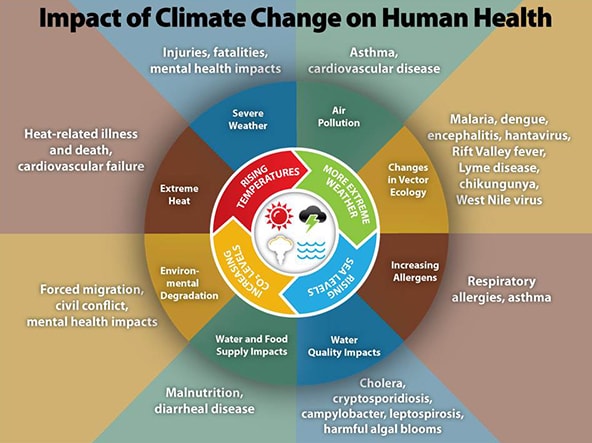
sea level rise may impact the execution of amphibious landings; changing temperatures and lengthened seasons could impact operation timing windows; and increased frequency of extreme weather could impact overflight possibility as well as intelligence, surveillance and reconnaissance capability. The opening of formerly-‐frozen Arctic sea lanes will increase the need for the Department to monitor events, safeguard freedom of navigation, and ensure stability in this resource-‐ rich area. Maintaining stability within and among other nations is an important means of avoiding full-‐ scale military conflicts. The impacts of climate change may cause instability in other countries by impairing access to food and water, damaging infrastructure, spreading disease, uprooting and displacing large numbers of people, compelling mass migration, interrupting commercial activity, or restricting electricity availability. These developments could undermine already-‐fragile governments that are unable to respond effectively or challenge currently-‐stable governments, as well as increasing competition and tension between countries vying for limited resources. These gaps in governance can create an avenue for extremist ideologies and conditions that foster terrorism.Besides global warming affecting military defense preparedness, there are also the increased threats to our health as laid out by the CDC
Then there is also the fact that the body cannot withstand explosions, which happen a lot as well. By January 27th there had already been 5 pipeline explosions, and a 2013 Chevron pipeline explosion needed a 1.5 mile evacuation zone.
Along with the 2010 BP spill which is widely cited as a concern in the Gulf, it is hardly the only incident even in recent months.
November 21 2014
(Reuters) - An explosion at oil and gas operator Fieldwood Energy's Echo Platform in the Gulf of Mexico on Thursday killed one person and injured at least one, but no pollution was reported, a U.S. safety agency and the company said.
December 19 2014
An explosion and fire early Friday morning killed two people and critically injured two others at an oil rig in southeastern Oklahoma.
Authorities said the explosion occurred at the rig about two miles west of Coalgate in a remote area of rural Coal County, about 100 miles southeast of Oklahoma City.
And here is some safety news from Canada
Latest pipeline #statistics: 5 accidents from Jan to Nov 2014, compared with 10 for the same period in 2013 http://t.co/kyZINXhE5V
— TSB of Canada (@TSBCanada) January 26, 2015
And currently we only have to worry about the safety of 2.5 million miles of pipeline
There are 2.5 million miles of pipeline currently operating in the U.S.
— Strong facts (@RealStrongfacts) January 23, 2015
I can understand Senator Sullivan and Ashton Carter's concerns about energy security and I agree that we should be worried about the future of US energy security and homeland security, but Senator Sullivan and many Republicans, as well as some Democrats and President Obama see continued and increased oil and gas drilling as the solution to both problems, even as accidents kill workers and normal production ruins our health and we must reduce by “at least 40% below the 1990 level” our greenhouse gas emissions by 2030 in order to limit the already begun effects of the changing climate--remember that some of these leases won't start until 2021 (emphasis mine)
Ms. Jewell said that since so little was known about the proposed Atlantic lease sale areas, the coming years would be devoted to exploration of the area to determine the extent of its oil and gas resources and ecological sensitivity. She said that the government was unlikely to sell a drilling lease before 2021, meaning it could be a decade before new drilling begins.
**IF you are willing to share your name publicly then comment on the proposition HERE by March 16th
There are also 4 public meetings scheduled
• New Orleans, Louisiana: Monday, February 23, 2015, Bureau of Ocean Energy Management, Gulf of Mexico OCS Region,
1201 Elmwood Park Boulevard, New Orleans, Louisiana 70123, one meeting beginning at 1:00
p.m. CST;
• Panama City, Florida: Tuesday, February 24, 2015, Wyndham Bay Point Resort,
4114 Jan Cooley Drive, Panama City Beach, Florida, 32408, one meeting beginning at 4:00 p.m. CST;
• Mobile, Alabama: Wednesday, February 25, 2015, Hilton Garden Inn Mobile West,
828 West I–65 Service Road South, Mobile, Alabama 36609, one meeting beginning at 4:00 p.m. CST;
• Gulfport, Mississippi: Thursday, February 26, 2015, Courtyard by Marriott, Gulfport Beachfront MS Hotel,
1600 East Beach Boulevard, Gulfport, Mississippi 39501, one meeting beginning at 4:00 p.m. CST.


